"The LORD brings the counsel of the nations to nothing; he frustrates the plans of the peoples. The counsel of the LORD stands forever, the plans of his heart to all generations. Blessed is the nation whose God is the LORD, the people whom he has chosen as his heritage!" (Psalm 33:10-12)
"For those whom he foreknew he also predestined to be conformed to the image of his Son, in order that he might be the firstborn among many brothers. And those whom he predestined he also called, and those whom he called he also justified, and those whom he justified he also glorified." (Romans 8:29-30)
Predestined and Foreknowledge Correctly Defined
Men will seemingly do anything in order to maintain their liberty; apparently even invent flaws in the Sovereignty of God if necessary. It is common place for Arminians and Pelagians to jump on the word "foreknew" in Romans 8:29, and use it to redefine the word "predestine". They tell us that God's predestination, per this passage, is contingent upon His 'foreknowing' man's choice". Such nonsense requires that,
First, Predestination be redefined. The term Predestined (proorizō προορίζω) is defined as "to limit in advance, that is, predetermine: - determine before, ordain. We are told by those who oppose us that God's predestination is contingent upon man's actions. This, by definition, is not predestination. The terms "predestination" and "contingency" are opposites. Events in history that are "contingent" are not "predestined". "Contingent Predestination" can no more exist than "cold heat" or "dry moisture"."
Second, God's omniscience be denied. God must first learn what choices His creation will make before He decrees anything. Thus God, getting wiser with time, is able to make better decisions based on this newfound knowledge. This can only work one of two ways. Either God "predestines" based on a foreknowledge of some inherent goodness in man that He was previously ignorant of, or else He "predestines" based on some accidental goodness that He was not the author of.
Third, God's omnipotence be denied. Rather than do whatever pleases Him (Psalm 115:3), God is subject to the actions of His own creation, actions that haven't even happened yet. In this case, God "predestines" events that He "foreknew" would happen anyway. Thus, in the end, God really predestines nothing, making His determinate counsel nothing more than a hopeful wish.
Now in case of the term "foreknowledge", it is ALWAYS used in Scripture to refer to persons, never their actions. In Romans 8:29, it is WHOM He foreknew, not what. In Acts 2:23, God's foreknowledge is used in conjunction with His "determinate counsel". The only other occurrences of "foreknowledge" are Romans 11:2 and 1 Peter 1:2, and in both cases, it refers to people, not their foreseen actions. Of course, God does foresee and foreknow our actions, because He predestines and works in them. There in nothing in Scripture that suggests that God predestines based on the foreknowledge of our actions. This is a doctrine built on theological desperation, not sound exegesis. (See August’s blog “Whom He foreknew”).
We need to define our Scriptural words with Scripture, not with Webster's Dictionary. In Scripture, the term "knowledge" is used as a way to express an intimate love or favorable regard. Three times in Genesis 4, we see that a man "knew" his wife, causing her to conceive and bare a son (Genesis 4:1, Genesis 4:17, Genesis 4:25). Surely the term "know" means more than "to be informed about". God told Israel that "You only have I known of all the families of the earth" (Amos 3:2). Did God not know about other families? Again, "If any man love God, the same is known of Him" (1 Corinthians 8:3). Of course, God knows those who do not love Him as well. When Jesus says to the wicked on the Day of Judgment, "Depart from Me, I never knew you..." (Matthew 7:23), He isn't telling them that He doesn't know who they are, or that He doesn't know anything about them. He is saying to them, "I never loved you with any redeeming love. You are not my sheep, and you shall not be mine. Therefore, depart from me, you who practice lawlessness".
Unconditional Election
Throughout Scripture, we see that God's predestination and election work independent of man's choices, ie. Unconditional Election. In Romans 9:11, God chose Jacob over Esau when "the children being not yet born, neither having done anything good or bad, that the purpose of God according to election might stand". Ephesians 1:4 says that "he chose us in him before the foundation of the world, that we should be holy and blameless before him", not because he foreknew that we would be holy and blameless. Ephesians 1:5 and Ephesians 1:11 agree that we were "predestined... according to the purpose of his will". In 2 Timothy 1:9, He "saved us, and called us with a holy calling, not according to our works, but according to his own purpose and grace, which was given to us through Christ Jesus before the world was". The first observation here is that we were saved, not according to our works (or wills), but according to His own purpose and grace". The second observation is that "grace was given us through Christ Jesus before the world was". Therefore, the grace that we have is not the result of foreseen faith, but according to His own purpose before the world was." 2 Thessalonians 2:13 tells us that "God chose you from the beginning unto salvation in sanctification of the Spirit and belief of the truth". "Belief of the truth" is part of what God chose for us from the beginning. Nothing pertaining to our salvation can be credited to us, "for by grace have ye been saved through faith; and that not of yourselves, it is the gift of God" (Ephesians 2:8). Despite the textual criticism in this passage, "faith" cannot be separated from this "gift of God", and made to stand on it's own. If faith were "of ourselves", then grace would not be a gift, but rather a reward for our faith.
Besides, those who reject faith as being a gift from God have no explanation for where faith comes from. Why is it that "not all have faith" (2 Thessalonians 3:2)? If it be attributed to "free will", and we grant that all men have the same "free will", then either 1.) All men would have the same faith, or 2.) Those who were able to obtain faith of their own resources have some inherent quality (wisdom, righteousness, etc.) in them that faithless men do not have. The first case, as 2 Thessalonians 3:2 points out, is unscriptural, as well as refuted by common observation. In the second case, since wisdom (James 1:5; James 3:17) and righteousness (Romans 5:17; Romans 10:3) are themselves gifts from God, we are right back where we started, with Unconditional election. According to Isaiah 43:10, we are chosen that we may believe, not on any condition that we do believe, "For it has been granted to you that for the sake of Christ you should not only believe in him but also suffer for his sake." (Philippians 1:29).
It has been suggested by some that the phrase "in Him" in Ephesians 1:4 refers to the position of believers who exercise their "free-will" prior to being chosen, rather then the result of being chosen. This holds no water, for we were chosen in Him before the foundation of the world, long before we had any will whatsoever. Jesus was very clear that no one could come to Him unless it was granted to him by the Father (John 6:65). Therefore, in order to be "in Him", we must first have it granted to us "by Him", for "of him are ye in Christ Jesus" (1 Corinthians 1:30).
Election or Ratification?
There are clear definitions to words in Scripture. The Arminians, Pelagians, Open Theists, and the like are stuck with the task of having to redefine words in order to make their theology work, such as "predestined", as I showed above. Another word that must be redefined is "election" (eklogē εκλογή). It is defined as "(divine) selection (abstractly or concretely): - chosen, election." It is no coincidence that the saints in Scripture are referred to as the "elect" of God (Matthew 24:22, Matthew 24:24, Matthew 24:31, Romans 8:33). Furthermore, it is written that this election is independent of man's choices, and is accomplished so "that the purpose of God according to election might stand" (Romans 9:11). Election means what it says, that God "elects" (chooses) the brethren beloved of God (1 Thessalonians 1:4). Those who oppose the Doctrines of Sovereign Grace will say that election, like predestination, is based on a "foreknowledge" of faith. This, by definition, is not election, but more akin to ratification. In this view, salvation falls into the frail hands of man, and if certain people make the correct decision, God comes along and puts His stamp of approval (ratifies) their choice. However, according to Scripture, "...many are called, but few chosen." (Matthew 22:14). Salvation is God's choice, for "God chooses his own heritage" (Psalm 33:12). As a result, "as many as had been appointed to eternal life believed" (Acts 13:48). He foreknew, predestined, called, justified, and glorified His elect (Romans 8:28-30). God did not appoint His elect to wrath, but to obtain salvation through our Lord Jesus Christ (1 Thessalonians 5:9). He chose His elect in Him before the foundation of the world, predestined them to adoption as sons, according to the good pleasure of His will (Ephesians 1:4-5). We were predestined according to the purpose of Him who works all things according to the counsel of His will (Ephesians 1:11). He has saved us and called us with a holy calling, not according to our works, but according to His own purpose and grace which was given to us in Christ Jesus before time began (2 Timothy 1:9). God does not leave the "choice" of salvation to man, but "God from the beginning chose us for salvation" (2 Thessalonians 2:13-14). In the end, those who are with Him are "called, chosen, and faithful" (Revelations 17:14). (By the way, the greek word for "church" [ekklēsia εκκλησία] literally means "the called out ones".)
Pharaoh vs. Paul
“For the Scripture says to the Pharaoh, "For this very purpose I have raised you up, that I may show My power in you, and that My name may be declared in all the earth." Therefore He has mercy on whom He wills, and whom He wills He hardens.” (Romans 9:17-18)
"And the Lord said unto him, Arise, and go to the street which is called Straight, and inquire in the house of Judas for one named Saul, a man of Tarsus: for behold, he prayeth; and he hath seen a man named Ananias coming in, and laying his hands on him, that he might receive his sight. But Ananias answered, Lord, I have heard from many of this man, how much evil he did to thy saints at Jerusalem: and here he hath authority from the chief priests to bind all that call upon thy name. But the Lord said unto him, Go thy way: for he is a chosen vessel unto me, to bear my name before the Gentiles and kings, and the children of Israel: for I will show him how many things he must suffer for my name's sake." (Acts 9:11-16)
"This is a true saying, and by all means worthy to be received, that Christ Jesus came into the world to save sinners, of whom I am chief." (1 Timothy 1:15)
In these passages, we have a lost sinner in Pharaoh and a saved sinner in Paul. We must ask, what made the difference? What was it that allowed Saul of Tarsus, the chief of sinners, to obtain mercy from God, while Pharaoh was rejected? The answer must come from Scripture itself, not our emotions. Certainly, it cannot be some inherent righteousness in Saul, nor can it rightly be said that Pharaoh was a worse or more obstinate sinner than Paul, for Paul was the chief of sinners.
Romans 9:18 gives us the answer. God has mercy on whom He wills, and whom He wills He hardens. His election is unconditional, as we saw with Jacob and Esau (Romans 9:11). God's purpose for raising up Pharaoh was to show His power by destroying him (Romans 9:17), where as Paul was chosen to bear the Lord's name to gentiles and kings (Acts 9:15). Each man served God's purpose.
The Scriptures plainly tell us that God hardened Pharaoh’s heart, so that He could lay His hand on (judge) Egypt.
“And I will harden Pharaoh's heart, and multiply My signs and My wonders in the land of Egypt. But Pharaoh will not heed you, so that I may lay My hand on Egypt and bring My armies and My people, the children of Israel, out of the land of Egypt by great judgments.” (Exodus 7:3-4)
It does not say that God “allowed” Pharaoh’s heart to be hardened. It says that God hardened it (and it says it on several occasions). Yet, Pharaoh was responsible for his wickedness. The Scriptures tell us that Pharaoh hardened his own heart. But that doesn't answer the most important question. Could Pharaoh have repented and overcome God’s hardening of His heart? How?
“The king's heart is in the hand of the LORD, Like the rivers of water; He turns it wherever He wishes.” (Proverbs 21:1)
“The LORD has made all for Himself, Yes, even the wicked for the day of doom.” (Proverbs 16:4)
As John Newton used to say, “…the Lord must have loved me before I was born, or else He would not have seen anything in me to love afterwards.”
The Immutability of God and His Decree
“I am the LORD, I change not,” (Malachi 3:6). This attribute of God, clearly stated in the Scriptures, has been challenged in some newer movements such as Open Theism, a heretical belief that God leaves future events "open" and dependent on human actions. (The title of Charles Hartshorne’s book “Omnipotence and Other Theological Mistakes” tells you all you need to know about this nonsense). This is easily refuted by Scripture. The God of the Bible has already declared "the end from the beginning, and from ancient times the things that are not yet done, saying, My counsel shall stand, and I will do all my pleasure,” (Isaiah 46:10).1 “As I have purposed, so shall it stand,” (Isaiah 14:24). God is "the Father of lights, with whom is no variableness, neither shadow of turning" (James 1:17). “But He is unique, and who can make Him change? And whatever His soul desires, that He does.” (Job 23:13). “Forever, O LORD, your word is firmly fixed in the heavens.” (Psalm 119:89).
Use of this Doctrine
David Chilton explains, "The Biblical doctrine of predestination, when rightly understood, should not be a source of fear for the Christian; rather, it is a source of comfort and assurance. The opposite of the doctrine of predestination is not freedom, but meaninglessness; if the smallest details of our lives are not part of the Plan of God, if they are not created facts with a divinely determined significance, then they can have no meaning at all. They cannot be "working together for good." But the Christian who understands the truth of God's sovereignty is assured thereby that nothing in his life is without meaning and purpose — that God has ordained all things for His glory and for our ultimate good. This means that even our sufferings are part of a consistent Plan; that when we are opposed, we need not fear that God has abandoned us. We can be secure in the knowledge that, since we have been "called according to His purpose" (Romans 8:28), all things in our life are a necessary aspect of that purpose. Martin Luther said: "It is, then, fundamentally necessary and wholesome for Christians to know that God foreknows nothing contingently, but that He foresees, purposes, and does all things according to His own immutable, eternal and infallible will. . . . For the Christian's chief and only comfort in adversity lies in knowing that God does not lie, but brings all things to pass immutably, and that His will cannot be resisted, altered or impeded."2
Objections
1.) God "repents" and seems to "change” His mind in Scripture.
There are some who would object to God's immutability based on a few incidents where God did seem to "change His mind". In Genesis 6:6, it reads, "And it repented the LORD that he had made man on the earth, and it grieved him at his heart." It must be noted that it does not say that God changed His mind, but that it "repented" or "sorrowed" the Lord (nâcham נחם). This is known as an anthropopathism, where God attributes human emotion or action to Himself to accommodate our limited understanding. God describes Himself as having eyes, ears, and hands, yet God is a Spirit (John 4:24) and has no body (Luke 24:39). He speaks of Himself as "waking" (Psalm 78:65), as "rising early" (Jeremiah 7:13); yet He neither slumbers nor sleeps (Psalm 121:4). In this same way, God can be said to "repent" or be "sorrowed", when in fact, "“God is not man, that he should lie, or a son of man, that he should change his mind. Has he said, and will he not do it? Or has he spoken, and will he not fulfill it?” (Numbers 23:19). If we are to use Genesis 6:6 as a case where God "changes his mind", we are faced with the monstrous absurdity that God made a mistake, was taken by surprise at man's wickedness, and had to resort to the flood as "Plan B" in order to correct the mistake.
Another related objection is the 15 years that God added to Hezekiah's life (2 Kings 20:1-6). Again, this whole episode was part of God's eternal, immutable secret counsel, for "in your book were written, every one of them, the days that were formed for me, when as yet there were none of them." (Psalm 139:16). At this point, I must point out that the Open Theist view that God can change His mind is a death blow to Arminian foreknowledge. Arminians and Pelagians insist that God "foreknows" all of men's actions, and establishes His decrees based on that foreknowledge. Yet, if God changed His mind about Hezekiah's days based on Hezekiah's prayer, then God apparently didn't foreknow that Hezekiah didn't really want to die. Based on this new information, God then was able to make a better decision and give Hezekiah the extra 15 years. (Most "Open Theists" will support what I just wrote wholeheartedly!!!)
Obviously, this is nonsense. It was God's "revealed will" that changed, not His mind, for "Known unto God are all his works from the beginning of the world,” (Acts 15:18). If God already knows all His works from the beginning of the world, he has no need to ever change His mind. Why would He, since "his way is perfect" (Psalm 18:30)? Perfection cannot be impr0ved on. “For the LORD of hosts has purposed, And who will annul it? His hand is stretched out, And who will turn it back?” (Isaiah 14:27). "For who has known the mind of the Lord, or who has been his counselor? (Romans 11:34)? Let the opposition continue to speak of this god who has everchanging, open decrees. In the end, “The counsel of the LORD stands for ever, the plans of his heart to all generations.” (Psalm 33:11).
2.) Does God elect arbitrarily? If not, what is the basis for His election?
That’s a good question. The answer is, “We don’t know”. The Bible never tells us why God predestines the sinful acts of the wicked, nor does it tell us on what basis He predestines and elects, other than "the good pleasure of his will" (Ephesians 1:5). Oceans of scholarly ink have been wasted in an effort to describe the secret things that belong to the Lord (Deuteronomy 29:29). All we know for sure, according to the Scriptures, is that God does predestine, and that He does so independent of man’s choices (for He did so before man ever had a choice). Romans 9:23 gives us a possible glimpse as to why God creates “vessels of wrath prepared for destruction”, “that he might declare the riches of his glory upon the vessels of mercy, which he hath prepared unto glory”. This seems to be validated in His words to Pharaoh, "For this very purpose I have raised you up, that I might show my power in you, and that my name might be proclaimed in all the earth." (Romans 9:17). In the end, God has one main goal and purpose, and that is to glorify Himself. God gets glory out of the salvation of His people, and He gets glory out of the destruction of the wicked.
3.) It is unfair of God to predestine men to Hell.
This objection overlooks Original Sin and man's inherent guilt3, and with the Doctrine of Predestination being plainly taught in Scripture, this objection ignores Scripture and appeals to emotion and human standards of fairness. The last thing that any human would ever truly want to do is appeal to God's "fairness" and "justice". If God were to merely operate in the realm of fairness, then no one would be saved. God could wipe out the entire human race and send everyone to Hell, and be totally fair in doing so. Mercy is the opposite of "fairness". Mercy, by definition, means that God does not give us what we deserve. Is God unfair? He sent Jesus to die for my sins. There has never been anything more "unfair" than that.
Besides, the Arminian god is not immune to similar criticism. After all, in Arminian theology, God "foreknows" who will reject Him and end up in Hell, yet He still chooses to create them anyway. Why? How is this any less objectionable then predestination? We have Jesus' own words that it is better for such a man to have never been born (Matthew 26:24). In the end, "our God is in the heavens: he hath done whatsoever he hath pleased". (Psalm 115:3). This is God's "job description".
4.) Election makes coming to Christ futile.
Unfortunately, the Doctrine of Election is portrayed as a negative, when it is actually a positive. Oh dear friend, election does not keep souls from turning to God. Rather, it is our own deceitful and desperately wicked hearts that keep us from God. Election does not make coming to Christ futile. Election makes coming to Christ possible. No truly penitent sinner has ever been turned away from Christ because of election. Without election, there would be no truly penitent sinners.
For further study, I would suggest reading the following books:
Reformed Doctrine of Predestination by Loraine Boettner
Institutes of the Christian Religion by John Calvin
Chosen by God by R. C. Sproul
Another Valuable resource is the DVD Amazing Grace: The History and Theology of Calvinism. Highly recommended.
Footnotes:
1 Compare this Scripture with Corvinus’s statement that “God doth not always foresee the event of what he intendeth.”
2 David Chilton, “Days of Vengeance: An Exposition on the Book of Revelation” p.100
3 Most people who call themselves Arminians today are surprised by the fact that classical Arminian scholars, agreeing with Pelagius, denied the doctrine of Original Sin. Corvinus claimed, “It is absurd that by one man’s disobedience many should be made actually disobedient,” thus a direct challenge to that authority of Romans 5:18-19. Venator says, ““Infants are simply in that estate in which Adam was before his fall”. The Doctrine of Original Sin is plainly taught in Scripture (Psalm 51:5; Psalm 58:3).

Wednesday, October 04, 2006


Monday, October 02, 2006
The Myth of Libertarian Free Will
"A new heart also will I give you, and a new spirit will I put within you, and I will take away the stony heart out of your body, and I will give you an heart of flesh. And I will put my spirit within you, and cause you to walk in my statutes, and ye shall keep my judgements and do them." (Ezekiel 36:26-27)1
"For doubtless, against thine holy Son Jesus, whom thou hast anointed, both Herod and Pontius Pilate, with the Gentiles and the people of Israel gathered themselves together, To do whatsoever thine hand, and thy counsel had determined before to be done." (Acts 4:27-28)
We see in these two scriptures, both a contrast and a similarity. The contrast is that, in the Ezekiel passage, God causes His People to walk in His Statutes while, in the Acts passage, God is actively working in the hearts of wicked men to whatever His counsel had determined to be done. The similarity is that God is sovereignly at work in both cases. There is a lot of talk among today's Christians about "Free-will". It is said that those of us who hold to the Doctrines of Sovereign Grace, otherwise known as Calvinism, oppose human "free-will". This is certainly not the case, for the Westminster Confession of Faith devotes the entire Chapter 9 to defending the free-will of man. The issue, however, is that those who oppose us insist on a sort of "Libertarian" free will, a free will without boundaries, a free will able to manipulate events in the Spiritual realm . In the end, however, all must acknowledge that man's will indeed has limitations. Just ask, "Is it possible for anyone to live an entire lifetime without sinning?" If the hearer has any Biblical sense about him at all, he will have to acknowledge that men are indeed "slaves to sin". (Romans 6:17-20; Titus 3:3; 2 Peter 2:19). See also, August’s Blog “Freedom of the will”.2
It is acknowledged by any sober-minded person that man does have a will. Furthermore, it is easily proven than man's will is "free" to do what he wants to do. The problem arises when man's "free will" seeks for itself to become divine, able to save lost sinners, and effecting what Christ's work on Calvary was apparently unable to complete. For the Arminians tell us that 'God is a gentleman, who will never go against man's "free will'", as if the Almighty God who created the universe and all things in it, sovereignly working all things to the council of His will (Ephesians 1:11), must bow to the liberty of His own creation. Thus God's Sovereignty is denied, and God is not God.
Man's will is no cure for the sinful nature, but is instead the cause. Man's will has been corrupted by the Fall, and therefore, must be redeemed along with the rest off our wicked selves. Even the most basic philosopher quickly learns that man's will is neither libertarian nor autonomous. It is a secondary entity which depends on many things. The very definition of a rational person is one whose will is under the control of reason and rational thinking. To be "free" from such would make one insane. Wills are controlled by emotions, love, hate, anger, sadness, etc. Diseases can affect wills. Drug addicts "freely" partake in the substance that enslaves them, a perfect illustration of man's willing slavery to sin, but slavery nonetheless. Every part of man has been spiritually killed by the fall. He is totally depraved, and will be condemned forever unless God intervene on His behalf. For, "he that believeth not is condemned already..." (John 3:18).
The weak "free will" philosophy has taken over modern evangelism. Instead of preaching "Good News", we have limited ourselves to "good advice". We plead for men to come to a begging Christ, who is standing on the sidelines just hoping that the wicked sinner can muster up enough faith of his own resources to let Jesus save him. Oddly enough, most Christians who preach this doctrine won't hesitate to pray for God to "save" lost loved ones, even though they teach that "God is a gentleman, who will never violate our free-will" (see Psalm 33:10-12). As John Owen pointed out in his chapter "The Idol of Free-will", man's will is not "free" until the Son makes him free. (John 8:36). Man's will is free only in the sense that he does what he wants to do. Man's will is not free to change his own sinful heart, as Ezekiel 36:26-27 shows. This is the work of God alone.
These Scriptures alone should be enough to refute libertarian "free-will".
God's Sovereignty in the Works of Man
"For doubtless, against thine holy Son Jesus, whom thou hast anointed, both Herod and Pontius Pilate, with the Gentiles and the people of Israel gathered themselves together, To do whatsoever thine hand, and thy counsel had determined before to be done." (Acts 4:27-28)
We see in these two scriptures, both a contrast and a similarity. The contrast is that, in the Ezekiel passage, God causes His People to walk in His Statutes while, in the Acts passage, God is actively working in the hearts of wicked men to whatever His counsel had determined to be done. The similarity is that God is sovereignly at work in both cases. There is a lot of talk among today's Christians about "Free-will". It is said that those of us who hold to the Doctrines of Sovereign Grace, otherwise known as Calvinism, oppose human "free-will". This is certainly not the case, for the Westminster Confession of Faith devotes the entire Chapter 9 to defending the free-will of man. The issue, however, is that those who oppose us insist on a sort of "Libertarian" free will, a free will without boundaries, a free will able to manipulate events in the Spiritual realm . In the end, however, all must acknowledge that man's will indeed has limitations. Just ask, "Is it possible for anyone to live an entire lifetime without sinning?" If the hearer has any Biblical sense about him at all, he will have to acknowledge that men are indeed "slaves to sin". (Romans 6:17-20; Titus 3:3; 2 Peter 2:19). See also, August’s Blog “Freedom of the will”.2
It is acknowledged by any sober-minded person that man does have a will. Furthermore, it is easily proven than man's will is "free" to do what he wants to do. The problem arises when man's "free will" seeks for itself to become divine, able to save lost sinners, and effecting what Christ's work on Calvary was apparently unable to complete. For the Arminians tell us that 'God is a gentleman, who will never go against man's "free will'", as if the Almighty God who created the universe and all things in it, sovereignly working all things to the council of His will (Ephesians 1:11), must bow to the liberty of His own creation. Thus God's Sovereignty is denied, and God is not God.
Man's will is no cure for the sinful nature, but is instead the cause. Man's will has been corrupted by the Fall, and therefore, must be redeemed along with the rest off our wicked selves. Even the most basic philosopher quickly learns that man's will is neither libertarian nor autonomous. It is a secondary entity which depends on many things. The very definition of a rational person is one whose will is under the control of reason and rational thinking. To be "free" from such would make one insane. Wills are controlled by emotions, love, hate, anger, sadness, etc. Diseases can affect wills. Drug addicts "freely" partake in the substance that enslaves them, a perfect illustration of man's willing slavery to sin, but slavery nonetheless. Every part of man has been spiritually killed by the fall. He is totally depraved, and will be condemned forever unless God intervene on His behalf. For, "he that believeth not is condemned already..." (John 3:18).
The weak "free will" philosophy has taken over modern evangelism. Instead of preaching "Good News", we have limited ourselves to "good advice". We plead for men to come to a begging Christ, who is standing on the sidelines just hoping that the wicked sinner can muster up enough faith of his own resources to let Jesus save him. Oddly enough, most Christians who preach this doctrine won't hesitate to pray for God to "save" lost loved ones, even though they teach that "God is a gentleman, who will never violate our free-will" (see Psalm 33:10-12). As John Owen pointed out in his chapter "The Idol of Free-will", man's will is not "free" until the Son makes him free. (John 8:36). Man's will is free only in the sense that he does what he wants to do. Man's will is not free to change his own sinful heart, as Ezekiel 36:26-27 shows. This is the work of God alone.
Total Depravity - What it isn't
Total Depravity does not mean that man is as bad as he could be, or that all men are equally bad. There are definitely some men who are worse than others. No one would suggest that Ghandi and Charles Manson were equally bad. In fact, the Bible teaches that there are stages to depravity (Romans 1:28-32), and that some are guilty of greater sins (John 19:11). What total depravity means is that man is totally helpless in initiating his own salvation. He is, in fact "dead in trespasses" (Ephesians 2:1). Every part of man; his body, soul, mind, emotions (and will), has been spiritually killed by the Fall, and in order to be redeemed, one must be born again (John 3:3).
The Sovereignty of God
Charles Spurgeon right observed that "Men will allow God to be everywhere except on his throne. They will allow him to be in his workshop to fashion worlds and to make stars. They will allow him to be in his almonry to dispense his alms and bestow his bounties. They will allow him to sustain the earth and bear up the pillars thereof, or light the lamps of heaven, or rule the waves of the ever-moving ocean; but when God ascends his throne, his creatures then gnash their teeth; and when we proclaim an enthroned God, and his right to do as he wills with his own, to dispose of his creatures as he thinks well, without consulting them in the matter, then it is that we are hissed and execrated, and then it is that men turn a deaf ear to us, for God on his throne is not the God they love. They love him anywhere better than they do when he sits with his scepter in his hand and his crown upon his head. But it is God upon the throne that we love to preach. It is God upon his throne whom we trust."3 Attempts have been made by many in all camps to "reconcile" the paradox between God's Sovereignty and man's "free-will", and volumes have been written in an effort to do just that. However, this alleged paradox is built on the assumption that man's will is capable of acting independent of God's decrees in even the least way. This idea is completely refuted in the opening Scriptures, as well as many others. God's sovereignty is openly declared throughout the Scriptures, whereas "free-will", especially as defined by Arminians and Pelagians, is absent.
"Remember the former things of old: for I am God, and there is none other God, and there is nothing like me, Which declare the last thing from the beginning: and from of old, the things that were not done, saying, My counsel shall stand, and I will do whatsoever I will. I call a bird from the East, and the man of my counsel from far: as I have spoken, so will I bring it to pass: I have purposed it, and I will do it." (Isaiah 46:9-11).
"But our God is in heaven: he doeth whatsoever he will." (Psalm 115:3)
"And all the inhabitants of the earth are reputed as nothing: and according to his will he worketh in the armies of heaven, and in the inhabitants of the earth: and none can stay his hand, nor say unto him, What doest thou?" (Daniel 4:35)
"The Lord breaketh the counsel of the nations, and bringeth to nought the plans of the people. The counsel of the Lord shall stand forever, and the plans of his heart throughout all generations. Blessed is that nation, whose God is the Lord: the people that he hath chosen for his own inheritance." (Psalm 33:10-12)
He "... worketh all things after the counsel of his own will," (Ephesians 1:11)
These Scriptures alone should be enough to refute libertarian "free-will".
God's Sovereignty in the Works of Man
Isaiah tells us that God "hast wrought all our works for us." (Isaiah 26:12). With regard to the continued attempt to deify man's will, Stephen Charnock asks, "But what if the foreknowledge of God, and the liberty of the will cannot be reconciled by man? Shall we therefore deny a perfection in God to support a liberty in ourselves? Shall we rather fasten ignorance upon God, and accuse Him of blindness to maintain our liberty?"4
Both Calvinists and Arminians believe in some sense that God has two "wills". The Calvinist holds that God has a "revealed" will (as given through his commandments"), and a secret will, His eternal decrees that are not revealed to man. Both of these are scriptural (Deuteronomy 29:29). The Arminian holds that God has a "perfect" will (which can be compared to His secret will) and a "permissive" will, a horrible monstrosity in which God relinquishes His sovereign governance and turns a portion of His kingdom over to who knows what (man, fate, the Devil)? The fact that God predestines all the works of man is offensive to the rebellious human heart, but cannot be denied from the Scriptures. God decrees and wills all things that have been and will ever be, “Declaring the end from the beginning, And from ancient times things that are not yet done, Saying, ‘My counsel shall stand, And I will do all My pleasure,” (Isaiah 46:10). God controls the steps (Jeremiah 10:23) and words of man (Proverbs 16:1) as well as heart of a king (Proverbs 21:1). In God “we live, and move, and have our being,” (Acts 17:28). He "upholds all things by the word of his power,” (Hebrews 1:3), that not even a sparrow falls to the ground without the will of his Father (Matthew 10:29). God fashioned the days of man, before they ever existed (Psalm 139:16). This is the God of the Bible, not the poor helpless being who sits on some distant throne hoping that His people will use their "free will" and let Him save them.
One of the most sobering aspects of God's sovereignty is His working in the sinful acts of wicked men. To most Christians today, it is a theological bombshell to hear that God wills all that happens, including man’s evil deeds. Not only that, but he uses the wickedness of man to bring about His Divine, immutable decree. According to Scripture, even Satan himself is in the hands of a Sovereign God. It is for this reason that many have sought to distinguish the will of God from the “permission” of God. However, God Himself has repudiated this distinction with His own Word, stating that He "works all things according to the counsel of His will” (Ephesians 1:11). God does not alter His decree based on our “free-will”, but acts totally independent of this idol.
While feeble-minded man attempts to remove God’s purposeful will from all calamity and replace it with only His distant permission, Job, after passing through his many trials at the hands of Satan, his friends, his family, and his enemies, declares, “Who among all these does not know That the hand of the LORD has done this?” (Job 12:9) Thus the idea of mere “permission” is fiction. As punishment for David’s sin, God proclaimed concerning Absalom’s incest that He would "raise up evil out of" David's own house, and declared it to be His work, stating boldly that “I will do this thing before all Israel and before the sun.” (2 Samuel 12:11-12). The envy, kidnapping, and lying of Joseph's brothers was a direct act of God (Genesis 45:7).
Christ was the “Lamb slain from the foundation of the world.” (Revelation 13:8) It was not only the permission, but the will of God for His Son to be slain (Luke 22:42). In fact, it was God Himself who performed the work, because it pleased Him to do so (Isaiah 53:10). God was actively working in the following sinful acts; that Judas betrayed Christ; that the Jews plotted to kill Him; and that the Romans carried out their act, for all these did nothing but "what the hand and counsel of God had decreed" (Acts 4:27-28). This is affirmed by Peter, that Christ was delivered to death by the determinate counsel and foreknowledge of God (Acts 2:23); in other words, that God, to whom all things are known from the beginning, had willed (not just permitted) what the Jews and Romans had executed. He repeats the same thing elsewhere, “Those things, which God before had showed by the mouth of all his prophets, that Christ should suffer, he has so fulfilled,” (Acts 3:18). They were all "disobedient to the word, to which they also were appointed. (1 Peter 2:8).
"I form the light and create darkness: I make peace and create evil: I the Lord do all these things." (Isaiah 45:7)
These are just a few passages that show that God not only created all things, but sovereignly governs all things according the council of His will, decreeing even sinful acts without being their author. Any other belief is an attempt by rebellious man to remove God from His throne and thrust His church into Deism, or even fatalism.
How does God decrees and work in the sinful acts of wicked men without being the author of sin (James 1:13)? The answer is that God does not force man to sin. He doesn't have to. While "in Him is no darkness" (1 John 1:5), man has enough sin in himself to accomplish all the evil that God could ever decree, for when a person sins, "each one is tempted, by his own desires being led away and enticed, afterward the desire having conceived, doth give birth to sin, and the sin having been perfected, doth bring forth death." (James 1:14-15). All God has to do is withhold grace, and "[deliver] them up unto a reprobate mind, to do those things which are not convenient..." (Romans 1:28). This is what man's "free will" profits him. While God Himself is not the tempter, but He does send evil and lying Spirits to accomplish these acts (See 1 Kings 22:19-23; 1 Samuel 16:14-23, 1 Samuel 18:10, 1 Samuel 19:9). God is said to "lay a stumbling block to make men fall" (Romans 9:33) and "send strong delusion, that they should believe lies," (2 Thessalonians 2:11). It is God alone who "hast set them in slippery places, and cast them down into desolation. How suddenly are they destroyed, perished and horribly consumed..." (Psalm 73:18-19). Thus, God can decree even man's evil deeds, and work to bring them to pass, yet a man's sins remains man's own, and he is fully responsible for them.
Salvation is of the Lord
"Blessed is the man whom thou choosest, and causest to approach unto thee, that he may dwell in thy courts..." (Psalm 65:4)
God is sovereign over the eternal destination of man. God Himself predestines the salvation of His elect (Acts 13:48; Ephesians 1:4-5; Ephesians 1:11; 2 Timothy 1:9; 2 Thessalonians 2:13-14), and He predestines the destruction of the wicked (Proverbs 16:4; Romans 9:21-22; Jude 1:4). However, it must be pointed out that, in both cases, men are still free to do what they want to do. There is a temptation here for many to stand in judgment of the Almighty. Paul, however, offers a stern rebuke to those who do so.
"Thou wilt say then unto me, Why doeth he yet complain? for who hath resisted his will? But, O man, who art thou which pleadest against God? shall the thing formed say to him that formed it, Why hast thou made me thus? Hath not the potter power of the clay to make of the same lump one vessel to honour, and another unto dishonour?" (Romans 9:19-21)
You must be born again.
The worst part of "free will" theology is that it undermines the need for the new birth. For free-willers tell us that man, by virtues of the intelligence, reason, and wisdom that he was created with, is able to effectively come to Christ an obtain salvation. This is commonly referred to as "Human Ability" and is refuted time and again by Scripture. Jesus tells us that "No man can come to me, except the Father, which hath sent me, draw him" (John 6:44), and again "no man can come unto me, except it be given unto him of my Father. (John 6:65). Human Ability, if taken to its logical conclusion, denies the need for the New Birth (John 3:3). It makes the work of the Holy Spirit in salvation either unnecessary, are at best, ineffective. However, the Bible is clear that a man must be born of the Spirit BEFORE he can even see the kingdom of God, let alone choose it. Human Ability gives natural man ability to receive the things of God, which the Scriptures specifically deny (1 Corinthians 2:14). Furthermore, Human Ability, as a contribution to salvation, is expressly denied in Scripture (John 1:12-13, Romans 9:16). Without the new birth, the things of the Kingdom of God appear to be foolishness. You must be born again. This is a supernatural event; one that man is totally incapable of doing.
Conclusion
The so-called paradox between God's Sovereignty and Man's "Free will" is a paradox invented by the minds of men. God's Sovereignty is clearly spelled out in the Scriptures, while man's freedom to act outside that sovereignty is but a pipe dream, and figment of man's vain imagination, the product not of the Divine Letter, but of human neurons. Nothing of this sort exists in the Scriptures. John Owen writes concerning the "Idol of Free Will", “What a stout idol is this, whom neither the Holy Spirit, the grace and counsel of God, the calling of the gospel, the knocking at the door of the heart, can move at all, or in the least measure prevail against him! Woe be unto us then, if when God calls us, our free-will be not in good temper and well disposed to hearken unto Him! For it seems there is no dealing with it by any other ways, though powerful and almighty. “For grant” saith Corvinus, “all the operations of grace which God can use in our conversion, yet conversion remaineth so in our own free power that we can be not converted; that is, we can either turn or not turn ourselves,” where the idol plainly challengeth the Lord to work His utmost and tells Him that after He hath so done, he will do what he please. His infallible prescience, His powerful predetermination, the moral efficacy of the gospel, the infusion of grace, the effectual operation of the Holy Spirit, all are nothing, not at all available in helping or furthering our independent wills in their proceedings. Well, then in what estate will you have the idol placed?”5
Objections
1.) God offers choices, and commands us to "choose" and "repent".
A common objection to this Sovereignty are the commands to "choose this day whom you will serve” (Joshua 24:15), and to "Repent therefore, and turn again, that your sins may be blotted out," (Acts 3:19). This is true, and God does offer this choice to all. However, man, in his fallen state, is unable to make that choice. Jesus commands us to Come to Him (Matthew 11:28), but then clearly states that no one can come to Him unless is has been granted to him by the Father (John 6:65). Paul tells us to “work out your own salvation with fear and trembling” (Phillipians 2:12), and then immediately adds, “for it is God who works in you both to will and to do for His good pleasure” (Phillipians 2:13). The Scriptures are clear. The ability to repent, obey, and respond to the gospel call is itself a gift from God. Therefore, God’s commandments to “Repent” do not presume our ability to do so. The sinner does not need good advice. He needs new life, and only God can give that. This was the basis for St. Augustine’s prayer that brought the Pelagian heresy out of the woodwork. “Lord, command what you will, and give what you command.” This is most necessary, for without Him, we can do nothing (John 15:5).
You will say to me, "I repent and ask for forgiveness". Why do you do that? Do you not see the hand of God in all of this? Did God not bring about all the details of your life to make you a Christian? Could you have just as easily been born the son of a Muslim, being taught that the best way to heaven is to blow yourself up in a Jihad? How is it that you came to the faith? Was it not Providence that allowed you to even learn of the Gospel? Did he not change your heart? What makes you different from others who do not believe?
2.) Doesn’t Calvinism make men out to be “Spiritual Robots”?
Man is not a Spiritual Robot. He is spiritually dead (Ephesians 2:1). We have already acknowledged that man has a will which is free to do what he wants to do. The problem is that what man wants to do is sin. It is his nature, and he is a slave to it (Romans 6:17). The entire man must be born of the Spirit before he can see the kingdom of God (John 3:3), and man's will is not exempt from this need (John 1:12-13).Angels are a perfect example of how to correctly view the Scriptures concerning will and predestination. It is no coincidence that the saved “angels” are referred to as “elect” (1 Timothy 5:21), whilst Hell is prepared for the Devil and his angels (Matthew 25:41). If anything in scripture is clear, it is that the final estate of angels is predestined. Yet, even the angels have the ability to think and morally reason independently. Hell was created specifically for the wicked angels. Yet, the substance of what guides their actions does not cease to be “will”. Therefore, with angels, we see a prime example of beings that have a “will”, yet their wills are not free. Elect Angels cannot be damned, nor can wicked ones be saved. Most Christians have no problem with God predestining angels, but yet they get most offended at the idea that God could do this with people. Why do we assume that our wills are freer than that of angels?In heaven, we cannot sin (Revelation 21:27). Does that mean that we will be Spiritual Robots? Of course not. It means that we will serve Him (Revelation 22:3), and do so willingly. In heaven, our wills will finally be free to "not sin".
3.) Why preach?
If God has already predetermined who would be saved, then why bother to preach the gospel? There are a few reasons. 1.) Jesus told us to (Matthew 28:18-20). 2.) The means in which God gathers His elect is "by the foolishness of preaching" (1 Corinthians 1:21). We don't know who the elect are, nor are we to presume who they are. What we do know is that some will accept it, and some will reject it. Why? If our answers are anything other than the sovereign election of God, then we have to assume some inherent goodness or wisdom in men that enables them to do this. Someone once commented to Charles Spurgeon that if he really believed in Calvinism, he shouldn't bother to preach. He replied, “God has called me to preach His Word, and if I knew that all the elect had a yellow stripe painted down their backs, then I would give up preaching the gospel and go lift up shirt tails.” As Calvinists, we can preach the Word, knowing that "...My word be that goes forth from My mouth; It shall not return to Me void, But it shall accomplish what I please, And it shall prosper in the thing for which I sent it." (Isaiah 55:11). Is this verse always true, or only when people are saved?
4.) Love and obedience cannot be true love and obedience without free will.
Says who? The opening verse (Ezekiel 36:27) is very clear in that God gives His people a heart to obey Him, and causes them to walk in His statutes (See also 2 Chronicles 30:12). Love must come from the heart, and true Godly love must come from a true Godly heart, not a deceitful and desperately wicked heart (Jeremiah 17:9). Man, by his fallen nature, drinks iniquity like water (Job 15:16); does not seek God (Romans 3:11); loves darkness and hates the light (John 3:19-20); is dead in trespasses (Ephesians 2:1); cannot understand things that are Spiritually discerned (1 Corinthians 2:14); is a slave to sin (John 8:34); can no more choose good than a leopard can change his spots (Jeremiah 13:23). This is why Jonah tells us that "Salvation is of the Lord" (Jonah 2:9). Paul agrees, telling us that "it is by grace alone, not of works, lest any man should boast". (Ephesians 2:8-9). Ezekiel could have prophesied to those dry bones until he was blue in the face (Ezekiel 37:1-10), but unless the Spirit of God comes down to give them life (Ezekiel 37:5-6), they will never choose anything. They are dead. So is fallen man spiritually dead (Ephesians 2:1, Colossians 2:13). Sinners do not need good advice. What they need is new life, and only God can give that.
5.) How can we be held responsible for our sins?
Man sins because he chooses to do so, making him fully responsible for his sins. Man's sins are his own. His "free will" is the cause of, not the cure for, the sinful nature. Man sins willingly, but out of necessity, because that is his nature. No mere human can go through life without sinning, no matter how much "freedom" he may claim for himself. Man is not "free" to change his own heart. This is the act of God alone.
For further study, I recommend the following Books.
The Bondage of the Will by Martin Luther
The Freedom of the Will by Jonathan Edwards
The Sovereignty of God by A.W. Pink
A Display of Arminianism by John Owen
The Existence and Attributes of God by Stephen Charnock
Footnotes:
1 Compare this Scripture with the statement by Corvinus that “God by his influence bestoweth nothing on the creature whereby it may be incited or helped in its actions.”
2 It must be noted that even God does not have Libertarian Free Will. There are some things God cannot do. God cannot lie, sin, change, or learn, etc.
3 Charles H. Spurgeon – Divine Sovereignty
4 Stephen Charnock - The Existence and Attributes of God
5 John Owen – A Display of Arminianism
Sunday, October 01, 2006
The Doctrines of Sovereign Grace
"And not only so, but also when Rebecca had conceived children by one man, our forefather Isaac, though they were not yet born and had done nothing either good or bad--in order that God's purpose of election might continue, not because of works but because of his call-- she was told, "The older will serve the younger." As it is written, "Jacob I loved, but Esau I hated." What shall we say then? Is there injustice on God's part? By no means! For he says to Moses, "I will have mercy on whom I have mercy, and I will have compassion on whom I have compassion." So then it depends not on human will or exertion, but on God, who has mercy. For the Scripture says to Pharaoh, "For this very purpose I have raised you up, that I might show my power in you, and that my name might be proclaimed in all the earth." So then he has mercy on whomever he wills, and he hardens whomever he wills. You will say to me then, "Why does he still find fault? For who can resist his will?" But who are you, O man, to answer back to God? Will what is molded say to its molder, "Why have you made me like this?" Has the potter no right over the clay, to make out of the same lump one vessel for honored use and another for dishonorable use? What if God, desiring to show his wrath and to make known his power, has endured with much patience vessels of wrath prepared for destruction, in order to make known the riches of his glory for vessels of mercy, which he has prepared beforehand for glory-- even us whom he has called, not from the Jews only but also from the Gentiles?" (Romans 9:10-24)
Introduction
It's that time of year again, October. This month has special significance for tho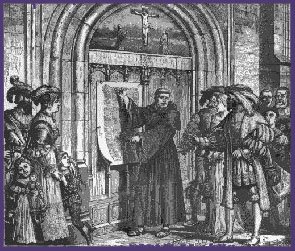 se of the Reformed Faith, as we remember October 31, 1517. Thus I will focus this month on a series on some Reformed Distinctives, beginning with the Five Points of Calvinism (yes folks, I am an unashamed, 5-point Calvinist, known in some circles as "Total Theological Depravity"). We will look at the issues that surrounded the Reformation, and examine some of the tough divisions between Romanism and the Reformed Faith. We will close the series with the Ramifications of the Doctrines. Why are they so important? I'll also interact with some of the blogs posted by August on his blog Omnipotent Grace, as he has already delved into a few of the issues. I'll also point out some of what I consider to be essential reading during this series of blogs.
Do I believe that a man must be a Calvinist to enter heaven? Be it far from me to ever suggest such. I know of a number of Godly men of whom the world is not worthy, men who at the same time hold to the erroneous doctrines of “free-will” salvation which I now detest. I can rightly testify that God regenerated my own heart as an Arminian, despite the fact that I gave myself too much glory for such salvation. As George Whitefield proclaimed when someone asked if he thought he would see John Wesley in heaven, "I fear not, for he will be so near the eternal throne and we at such a distance, we shall hardly get sight of him."
The passage of Scripture quoted in Romans is what started me on my road to Geneva, so to speak. (I once was an Arminian, but now I see). Romans Chapter 9 contains all of the "five points", and will be expounded in detail as I deal with those five points. However, before I delve into this, a few words about the so-called "Five Points of Calvinism". (We refer to Calvinism as The Doctrines of Sovereign Grace.)
First of all, John Calvin knew nothing about "five points". The so-called "Five Points of Calvinism" were a biblical response to the "Five Points of Arminianism" presented by the Remonstrance at the Synod of Dort in 1618, 54 years after Calvin's death.
Second, the theology referred to as "Calvinism" did not originate with Calvin. It was the theology of Luther, of the Reformers, of Augustine, and, dare I say, of Paul. As Charles Spurgeon said, "It is a nickname to call it Calvinism. Calvinism is the gospel and nothing else".
Third, the debate is an old one, beginning way before Calvin or Arminius. It began in the 4th Century with the Pelagian Heresy. . (Whenever I debate diehard Catholics in this area, I always refer to St. Augustine of Hippo.) Luther and Erasmus debated the same issue a generation before Calvin.
A good comparison of the "five points" can be found here
.
Jonah tells us that “Salvation is of the Lord” (Jonah 2:9). This is the clearest, most straightforward, no-nonsense Bible Doctrine of salvation, and I wish to know no other. I have no use for a temporary, man-initiated salvation. Give me the Doctrine of Salvation that Paul and Silas used to overthrow the Roman Empire. Give me the Doctrine of Salvation that Augustine preached that converted all of pagan Europe. Give me the Doctrine of Salvation that the Pilgrims and Puritans used to shake off the bands of tyranny to found this United States of America. Give me the Doctrine of Salvation that once shook the colonies and their European mothers in what was The Great Awakening. May we yet have another revival such as this one.
"I consider myself convicted by the testimony of Holy Scripture, which is my basis; my conscience is captive to the Word of God." - Martin Luther
Introduction
It's that time of year again, October. This month has special significance for tho
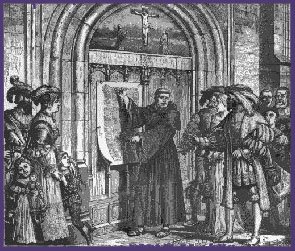 se of the Reformed Faith, as we remember October 31, 1517. Thus I will focus this month on a series on some Reformed Distinctives, beginning with the Five Points of Calvinism (yes folks, I am an unashamed, 5-point Calvinist, known in some circles as "Total Theological Depravity"). We will look at the issues that surrounded the Reformation, and examine some of the tough divisions between Romanism and the Reformed Faith. We will close the series with the Ramifications of the Doctrines. Why are they so important? I'll also interact with some of the blogs posted by August on his blog Omnipotent Grace, as he has already delved into a few of the issues. I'll also point out some of what I consider to be essential reading during this series of blogs.
Do I believe that a man must be a Calvinist to enter heaven? Be it far from me to ever suggest such. I know of a number of Godly men of whom the world is not worthy, men who at the same time hold to the erroneous doctrines of “free-will” salvation which I now detest. I can rightly testify that God regenerated my own heart as an Arminian, despite the fact that I gave myself too much glory for such salvation. As George Whitefield proclaimed when someone asked if he thought he would see John Wesley in heaven, "I fear not, for he will be so near the eternal throne and we at such a distance, we shall hardly get sight of him."
The passage of Scripture quoted in Romans is what started me on my road to Geneva, so to speak. (I once was an Arminian, but now I see). Romans Chapter 9 contains all of the "five points", and will be expounded in detail as I deal with those five points. However, before I delve into this, a few words about the so-called "Five Points of Calvinism". (We refer to Calvinism as The Doctrines of Sovereign Grace.)
First of all, John Calvin knew nothing about "five points". The so-called "Five Points of Calvinism" were a biblical response to the "Five Points of Arminianism" presented by the Remonstrance at the Synod of Dort in 1618, 54 years after Calvin's death.
Second, the theology referred to as "Calvinism" did not originate with Calvin. It was the theology of Luther, of the Reformers, of Augustine, and, dare I say, of Paul. As Charles Spurgeon said, "It is a nickname to call it Calvinism. Calvinism is the gospel and nothing else".
Third, the debate is an old one, beginning way before Calvin or Arminius. It began in the 4th Century with the Pelagian Heresy. . (Whenever I debate diehard Catholics in this area, I always refer to St. Augustine of Hippo.) Luther and Erasmus debated the same issue a generation before Calvin.
A good comparison of the "five points" can be found here
.
Calvinism | Arminianism |
| T=Total Depravity | Human Ability |
| U=Unconditional Election | Conditional Election |
| L=Limited Atonement | Universal Atonement |
| I=Irresistable Grace | Resistable Grace |
| P=Perseverence of the Saints | Falling from Grace |
Jonah tells us that “Salvation is of the Lord” (Jonah 2:9). This is the clearest, most straightforward, no-nonsense Bible Doctrine of salvation, and I wish to know no other. I have no use for a temporary, man-initiated salvation. Give me the Doctrine of Salvation that Paul and Silas used to overthrow the Roman Empire. Give me the Doctrine of Salvation that Augustine preached that converted all of pagan Europe. Give me the Doctrine of Salvation that the Pilgrims and Puritans used to shake off the bands of tyranny to found this United States of America. Give me the Doctrine of Salvation that once shook the colonies and their European mothers in what was The Great Awakening. May we yet have another revival such as this one.
Wednesday, September 27, 2006
A Few Thoughts on Christian Liberty
"Now concerning food offered to idols: we know that "all of us possess knowledge." This "knowledge" puffs up, but love builds up. If anyone imagines that he knows something, he does not yet know as he ought to know. But if anyone loves God, he is known by God. Therefore, as to the eating of food offered to idols, we know that "an idol has no real existence," and that "there is no God but one." For although there may be so-called gods in heaven or on earth--as indeed there are many "gods" and many "lords"-- yet for us there is one God, the Father, from whom are all things and for whom we exist, and one Lord, Jesus Christ, through whom are all things and through whom we exist. However, not all possess this knowledge. But some, through former association with idols, eat food as really offered to an idol, and their conscience, being weak, is defiled. Food will not commend us to God. We are no worse off if we do not eat, and no better off if we do. But take care that this right of yours does not somehow become a stumbling block to the weak. For if anyone sees you who have knowledge eating in an idol's temple, will he not be encouraged, if his conscience is weak, to eat food offered to idols? And so by your knowledge this weak person is destroyed, the brother for whom Christ died. Thus, sinning against your brothers and wounding their conscience when it is weak, you sin against Christ. Therefore, if food makes my brother stumble, I will never eat meat, lest I make my brother stumble." (1 Corinthians 8:1-13).
Legalism. It's a word that is thrown around in churches, rather loosely at times. Just what defines legalism depends on who you ask. Most dispensationalists would define a legalist as anyone who preaches or teaches obedience to God's law, thus making Jesus Christ Himself a "legalist" (Matthew 5:17-18). One of the godfathers of dispensationalism, Charles Ryrie writes, "our Lord... terminated the Law and provided a new and living way to God". I'll deal more with this nonsense in another discourse, but for the present subject, we'll focus in on the need for God's Law as a remedy, rather than a cause, of legalism. As it turns out, some of our more dispensationalist churches are the most legalistic. Having removed God's Law as a standard for righteous living, they are free to create their own laws. These legalistic rules range from forbidding the use of alcoholic beverages (which the Bible allows) to the more left wing "What would Jesus Drive?" condemnation of Sports Utility Vehicles, all without the slightest mention of such regulations in Scripture. The blessed part about being a Christian is that we are free from man-made religious ordinances. We are free to eat what we want, drink what we want, and yes, drive what we want. For "... if the Son sets you free, you will be free indeed" (John 8:36).
In 1 Corinthians 8, Paul was dealing with the issue of eating meats offered to idols. Obviously, this isn't much of an issue today, but we can glean much in the area of Christian liberty from this passage. Of course you can eat the meat, Paul tells the Corinthians, for "Food will not commend us to God. We are no worse off if we do not eat, and no better off if we do" (1 Corinthians 8:8). This is because "an idol has no real existence" (1 Corinthians 8:4). The same can be said for drinking alcoholic beverages, listening to secular music, use of tobacco products, the celebration of holidays (including Halloween1), eating meat, and driving SUVs. The commandments of men to "forbid marriage and require abstinence from foods that God created" is referred to as "seducing spirits, and doctrines of devils" (1 Timothy 4:1-2). While everyone has different standards for their own lives concerning these issues, the Bible leaves the final decision up to the individual to decide. “So let no one judge you in food or in drink, or regarding a festival or a new moon or sabbaths” (Colossians 2:16). While the church cannot condone what the Bible forbids (see United Church of Christ backs gay marriage) neither can the church forbid what the Bible allows (See Does Scripture Permit Us to Drink Alcoholic Beverages?). However...
This isn't the end of Paul's answer, and we need to consider the rest of the story in regard to Christian Liberty. Obviously, Christian liberty does not give us the freedom to disobey civil ordinances just because the Bible doesn’t specifically support the ordinance (Romans 13:1-7). Freedom to partake of alcohol requires a certain age, and disobedience to that requirement is a sin against God. Freedom to listen to secular music or go to the movie theatre doesn’t mean that we shouldn’t guard carefully what enters our ears and eyes (See Job 31:1 and Psalm 103:3. David can give you a firsthand testimony about the need to guard one’s eyes.) As we study further in 1 Corinthians 8, Paul exhorts us to "...take care that this right of yours does not somehow become a stumbling block to the weak. For if anyone sees you who have knowledge eating in an idol's temple, will he not be encouraged, if his conscience is weak, to eat food offered to idols?" (1 Corinthians 8:9-10). As a result, “the weak person is destroyed" (1 Corinthians 8:11). For example, I am free, as a Christian, to partake of alcohol. However, most of my Christian friends abhor the use of alcohol and are offended by it. Should I rub it in their faces as a matter of Christian liberty? Furthermore, several of my Christian friends are former alcoholics. It would not only be foolish to offer them a drink in the name of Christian liberty, but a sin against Christ (1 Corinthians 8:12). As Christians, we have great freedom in Christ. However, with freedom comes the responsibility to exhort and strengthen weaker brethren, even if it means giving up some of our freedom. (We can always have a beer in the privacy of our own homes). "Therefore, if food makes my brother stumble, I will never eat meat, lest I make my brother stumble" (1 Corinthians 8:13), (or have a beer).
Footnotes:
1.) There has been a lot of, to put it politely, bad information regarding the History of Halloween. Dennis Rupert wrote a good article to sort fact from fiction called The History of Halloween -- It's Probably Not What You Think. That said, a Christian parent should really consider the kind of costume that his child wears.
The Lost Doctrine of Eternal Hell
“This Doctrine is indeed awful and dreadful yet ‘tis of God” – Jonathan Edwards
"For we know him who said, "Vengeance is mine; I will repay." And again, "The Lord will judge his people." It is a fearful thing to fall into the hands of the living God." (Hebrews 10:30-31).

I dare say that there is not a lot of consideration today of the subject matter of which you are about to read. The topic of Hell is truly a lost doctrine today. Arthur Pink laments, "It is sad to find so many professing Christians who appear to regard the wrath of God as something for which they need to make an apology, or at least they wish there were no such thing. While some would not go so far as to openly admit that they consider it a blemish on the Divine character, yet they are far from regarding it with delight, they like not to think about it, and they rarely hear it mentioned without a secret resentment rising up in their hearts against it. Even with those who are more sober in their judgment, not a few seem to imagine that there is a severity about the Divine wrath which is too terrifying to form a theme for profitable contemplation. Others harbor the delusion that God’s wrath is not consistent with His goodness, and so seek to banish it from their thoughts." (The Attributes of God, p. 84).
According to most polls, the percentage of Americans who believe in Heaven ranges from 80% to 90%, while the percentage who believe in Hell ranged between 40% and 70%. The saddest part is that these numbers aren't much different among professing Christians. However, I must make it clear from the outset that anyone who would reject this doctrine cannot be called a Christian. Those who reject the doctrine of God's eternal wrath upon the wicked do not love the God of the Bible, but a false god, an idol of their own vain imaginations. Of them it is written, they "will secretly bring in destructive heresies, even denying the Master who bought them, bringing upon themselves swift destruction." (2 Peter 2:1)
The God of the Bible is not apprehensive concerning His wrath, nor does He shy away in shame at its mention. His own challenge is "See now that I, even I, am He, and there is no god with Me: I kill, and I make alive; I wound, and I heal; neither is there any that can deliver out of My hand. For I lift up My hand to heaven, and say, I live forever, If I whet My glittering sword, and Mine hand take hold on judgment; I will render vengeance to Mine enemies, and will reward them that hate Me" (Deut. 32:39-41). The Bible knows nothing of a god that is "too nice" to judge wickedness. In fact, a quick study of the Scriptures will show that there are more verses referring to God's anger and vengeance than there are to His love and mercy. Because God is holy, He hates all sin; And because He hates all sin, His anger burns hot against the sinner every day (Psalm 7:11). This is a doctrine that no preacher of righteousness has a right to ignore.
The Doctrine of Judgment in Christian Orthodoxy
The Eternal punishment of the wicked was taught among the earliest Christians. In his Letter to the Ephesians 16:1-2, Ignatius of Antioch (110 AD) writes, "Corrupters of families will not inherit the kingdom of God. And if they who do these things according to the flesh suffer death, how much more if a man corrupt by evil reaching the faith of God for the sake of which Jesus Christ was crucified? A man become so foul will depart into unquenchable fire, and so will anyone who listens to him." Clement of Alexandria (150 AD) writes, "If we do the will of Christ, we shall obtain rest; but if not, if we neglect his commandments, nothing will rescue us from eternal punishment." (Second Clement 5:5). Irenaeus (189 AD), the Second Century Bishop of Lyon, adds in his work "Against Heresies", "The penalty increases for those who do not believe the Word of God and despise his coming. . . . It is not merely temporal, but eternal. To whomsoever the Lord shall say, "Depart from me, accursed ones, into the everlasting fire," they will be damned forever." (Against Heresies 4:28:2). Similar statements can be found in works by Justin Martyr1, The Martyrdom of Polycarp2, Athenagoras3, Theophilus of Antioch4, Hippolytus5, Minucius Felix6, Cyprian7, and Cyril of Jerusalem8, and many others.
The Doctrine of Eternal Judgment has also been clearly established from the earliest Christian Creeds and Confessions. The Apostles Creed states, “He shall come to judge the living and the dead.” The Nicene Creed adds that Christ will come "to judge the quick and the dead”. The Athanasian Creed expounds even further, stating; “From thence He shall come to judge the living and the dead. At whose coming all men shall rise again with their bodies; and shall give account of their own works. And they that have done good shall go into life everlasting, and they that have done evil into everlasting fire.”
Despite the words of these Church Fathers, and the clear warnings from Scripture, it didn't take long for the strange and perverse musings of wolves to enter in among the sheep. The doctrine known of Annihilationism (the wicked will cease to exist) began in 4th-century with Arnobius. Noted Church Historian Phillip Schaff writes, “Arnobius… seems to have believed in actual annihilation; for he speaks of certain souls that "are engulfed and burned up," or "hurled down and having been reduced to nothing, vanish in the frustration of a perpetual destruction". (History of the Christian Church Vol. II, CHAPTER XII ). This belief is held today by cultists such as the Jehovah's Witnesses and Christadelphians. Annihilationism was condemned as heresy at the Second Council of Constantinople in 553 A.D.
The Doctrine of Restorationism (a belief in a temporary, remedial punishment, the basis for the modern belief in Universalism) arose from the Alexandrian school of theology, most notably with Origen. This heresy was combated by Epiphanes, Jerome, and Augustine.
Pope Gregory I was the first to formalize teachings in the Catholic Church surrounding Purgatory, a place of temporal punishment for post-baptismal sins. Unfortunately, this heresy has become a mainstay in the Roman Catholic Church, and was the lead grounds for the Reformation. However, aside these exceptions, the Christian Church has always held the Doctrine of the Eternal Punishment of the Wicked to be the ONLY orthodox Christian position.
The Westminster Confession Chapter 33, Section 2 states, "The end of God’s appointing this day is for the manifestation of the glory of His mercy, in the eternal salvation of the elect (Matthew 25:21; Romans 9:23); and of His justice, in the damnation of the reprobate who are wicked and disobedient (Romans 2:5-6; Romans 9:22; 2 Thess. 1:7-8). For then shall the righteous go into everlasting life, and receive that fulness of joy and refreshing, which shall come from the presence of the Lord (Matthew 25:31-34; Acts 3:19; 2 Thess. 1:1-12) but the wicked, who know not God, and obey not the Gospel of Jesus Christ, shall be cast into eternal torments, and be punished with everlasting destruction from the presence of the Lord, and from the glory of His power (Matthew 25:41, Matthew 25:46; 2 Thess. 1:9)."
Since the Reformation, other heresies, such as Universalism (universal salvation) have crept in. Those who hold these beliefs rarely appeal to scripture, but rather emotionalism9. They usually reason that God's punishments are reformatory rather than punitive. This brings us an obvious question. If the unregenerate wicked can still be saved by "the fires of Hell", thus effecting what the Cross of Christ failed to accomplish, then to what purpose was Christ's sacrifice? If Godly discipline were all that was needed to bring about eternal salvation, could God not have spared His only Son? God Himself refers to His judgments as "wrath", "fury", and "vengeance". Nothing about the judgments against the wicked could be mistaken for rehabilitation.
Some modern day universalists bolster their beliefs on the vain use of Near Death Experiences (NDE's). Many alleged "visions of heaven" and "light" have occurred within NDE's among individuals of various faiths, or even no faith at all. While I am skeptical of NDE's being anything more than hallucinations for the ill or dreams for the sleeping, we must also remember that "even Satan disguises himself as an angel of light." (2 Cor. 11:14). Any theology that exalts NDE's over the clear teachings of Scripture is a folly of fools (Proverbs 15:14).
Hell Defined by Scripture
The Hebrew word (she'ôl she'ôl שׁאל ׁאול), Greek Hades - literally "unseen" ( ᾅδης), has multiple meanings, including the grave, hell, and pit. Despite these various definitions, there can be no doubt that multiple instance of she'ôl and Hades refer to the abode of the damned, as it is taken in Luke 16:23. Various synonyms of it occur in the Scriptures, such as ('ăbaddôn אבדּון, see Proverbs 15:11) or perdition (see Proverbs 27:20). Consider these passages:The wicked "in a moment they go down to Sheol." (Job 21:13). "The wicked shall be turned back unto Sheol." (Psalm 9:17). If these references were taken to be the grave, than why single out the wicked, since the righteous will also face the grave? "Thou shalt beat him with the rod, And shalt deliver his soul from Sheol." (Proverbs 23:14). Can anyone rightly suggest that parental discipline can rescue a child from the grave? "Sheol and Abaddon are never satisfied" (Proverbs 27:20). Here Sheol is used along with Abaddon (destruction), the name of the angel from the bottomless pit (Rev. 9:11).
The word Gehenna (γέεννα - see Matthew 5:22; Matthew 5:29), is a word derived from the valley of Hinnom, in which the wicked Israelites were accustomed to practice horrible idolatries to Moloch, the idol of the Ammonites. It is synonymous with "everlasting punishment" Jesus identifies Gehenna with Isaiah 66:23-24 by speaking of it as the place of "The gnawing worm" and "unquenchable fire" (Mark 9:44). In its context, Jesus is adamant that Hell is worse than bodily mutilation and is to be avoided at all costs.
The word Tartarus (ταρταρόω) is only used once (2 Peter 2:4). It is derived from the lowest compartment of the pagan Greek Hades, recognized by mythology (Homer's Odyssey 11:575 and Plato's Gorgias) as a place for eternal judgment. For Peter to have chosen this word for a place of temporal punishment would have been most deceptive. Jesus will tell the wicked to "Depart from me, ye cursed, into the eternal fire which is prepared for the devil and his angels" (Matthew 25:41). Therefore, a consistent universalist must believe in the eventual salvation of the Devil himself, a most foolish doctrine.
William G.T. Shedd writes, "The strongest support of the doctrine of Endless Punishment is the teaching of Christ, the Redeemer of man...To threaten with “everlasting punishment” a class of persons described as “goats upon the left hand” of the Eternal Judge, while knowing at the same time that this class would ultimately have the same holiness and happiness with those described as “sheep upon the right hand” of the judge, would have been both falsehood and folly." (The Doctrine of Endless Punishment, pp. 14-15).
According to the Scriptures, Hell is "…to be feared" (Luke 12:4-5); "…to be avoided at all costs" (Matthew 5:29-30), "…a fiery furnace" (Matthew 13:42), "…a lake of burning sulfur" (Rev. 20:10). "…everlasting" (2 Thess. 1:9), "…unquenchable" (Matthew 2:12), "…eternal" (Jude 1:7). In Hell, there "…will be weeping and gnashing of teeth." (Matthew 8:12), for it is a place where the "…worm does not die and the fire is not quenched." (Mark 9:44-48). For those who go there, "…it would be better to have never been born" (Matthew 26:24). It was universally accepted by the ancient Jews and Greeks that there would be a place of eternal torment. If Jesus or His Disciples actually believed Hell to be a place of temporal punishment or annihilation, they would have been purposely misleading their listeners. No modern reader of the above scriptures, much less an ancient one, could have ever guessed that all men without exception would eventually be holy and happy in heaven.
Unfortunately, the treatment of the Doctrine of Hell in modern churches isn't much better. Today's Seeker Sensitive preachers tell us that "the worst part of Hell is the eternal separation from the presence of God". Really? If that is true, then Hell is really no threat at all to the unrepentant sinner, who has already lived most of his life outside of God. Hell would be the ideal place for the ACLU attorney, who not only wants to live outside the presence of God, but wants to make sure that everyone else does as well.
However, those in Hell are NOT physically separated from the presence of God. That is a myth, mere wishful thinking. Rev. 14:10 tells us that the wicked "shall be tormented with fire and brimstone in the presence of the holy angels, and in the presence of the Lamb". No my friend, it is not the absence of God that is the true horror of Hell, but rather His presence. In Hell, God will be there to personally pour out the fire of His Divine wrath upon the damned. It is there that He will "hate" and "abhor" you (Psalm 5:5-6). Your cries for mercy will fall on His deaf ears as He "will laugh at you calamity and mock at your terror" (Proverbs 1:26). Hebrews 10:31, a scripture that you won't find on many bumper stickers and T-shirts, states this quite accurately. Indeed, "It is a fearful thing to fall into the hands of the living God."
Hell will be the destination for…The Devil (Rev. 20:10) and His Angels. (Matthew 25:41); whoever’s name is not found written in the book of life (Rev. 20:15); dogs, sorcerers, sexually immoral, murderers, idolaters, liars. (Rev. 22:15); the sexually immoral, idolaters, adulterers, homosexuals, thieves, the greedy, drunkards, revilers, and swindlers (1 Cor. 6:9-10); and Hypocrites (known by today's terminology as “Carnal” Christians). i.e., professing Christians who practice lawlessness (Matthew 7:21-23), who attempt to come to the feast without the proper garments (Matthew 22:12-14).
Hell is eternal. It is a place of “everlasting punishment” (Matthew 25:46). If it were just for a million years, then one could have hope in Hell. But there is no such fortune for the wicked. There is no parole from Hell. There will never be a moment when the lost man can say, “Release me, I’ve served my time”. After he has spent 1 Billion years suffering Hell’s eternal torments, he will be no closer to the end of his punishment then he was at the beginning. A damned sinner will be released from Hell on the very day that God stops hating sin, never. It is the height of foolishness to think that the worst thing we have to fear is annihilation or separation from the presence of God. As the sign above Dante’s inferno reads: “Abandon hope, all ye who enter here.”
The Purpose of this Doctrine
The Doctrine of Eternal Damnation is essential both for proper self-examination and for Revival. Historically, Hell was the focus of the preaching surrounding The Great Awakening. Let one peruse the sermons of George Whitefield, who preached the judgment of God with Puritan fire. Glance at the words of Jonathan Edward's famous sermon Sinners in the Hands of and Angry God. This is the kind of preaching that brings about true revival. The modern church, on the other hand, attempts to remove the fear of God (Proverbs 1:7; Matthew 10:28) rather than promote it. Gary North laments, "“Is it any wonder that the doctrine of eternal damnation is de-emphasized in preaching today? Is it any wonder that God is spoken of mostly as a God of love, and seldom as the God of indescribable eternal wrath? D. L. Moody, the turn-of-the-century American evangelist, set the pattern by refusing to preach about hell. He made the preposterous statement that "Terror never brought a man in yet." That a major evangelist could make such a theologically unsupported statement and expect anyone to take him seriously testifies to the theologically debased state of modern evangelicalism. It has gotten no better since he said it.” While we certainly should never ignore God's love, we also cannot ignore the fact the God is ANGRY. In fact, "God is angry with the wicked every day. (Psalm 7:11). "A fire is kindled in mine anger". (Jer. 15:14). Since the Bible itself speaks more about God's wrath and anger than about His love and mercy, the church should at least give equal attention to it. Proper, biblical evangelism requires, even demands that we bring the unregenerate sinner to the sobering reality that he is in terrible danger. His very next breath could be a scream of agony as he is cast into the winepress of God's wrath while his blood splatters the garments of the Most High. (Isaiah 63:3). With due respect to Rev. Moody's ridiculous comment; we can take our theology of evangelism from the greatest evangelist the world has ever known. The Apostle Paul made no apologies whatsoever for God's wrath, nor did he shy away from this doctrine in his ministry. "Knowing therefore the terror of the Lord, we persuade men". (2 Cor. 5:11).
It is a dangerous thing to be ignorant or careless concerning one's eternal path, for wide is the gate, and broad is the way, that leads to destruction, and many are they that enter in thereby. (Matthew 7:13). Indeed, many of these poor souls have already gone before, who never imagined that they would ever end up in Hell, yet suddenly and without warning find themselves there. Hear them cry out, "Let him dip the tip of his finger in water, and cool my tongue: for I am tormented in this flame." (Luke 16:24). Listen to them plead, "Send out from the dead to my fathers house, For I have five brothers, so he may testify to them, lest they also come into this place of torment." (Luke 16:27-28). May these pitiful sighs from the voices of the damned pierce our flinty hearts, so that we may run to Christ and not suffer the same judgment.
Footnotes:
1.) Justin Martyr: "No more is it possible for the evildoer, the avaricious, and the treacherous to hide from God than it is for the virtuous. Every man will receive the eternal punishment or reward which his actions deserve. Indeed, if all men recognized this, no one would choose evil even for a short time, knowing that he would incur the eternal sentence of fire. On the contrary, he would take every means to control himself and to adorn himself in virtue, so that he might obtain the good gifts of God and escape the punishments" (First Apology 12).
2.) The Martyrdom of Polycarp "Fixing their minds on the grace of Christ, [the martyrs] despised worldly tortures and purchased eternal life with but a single hour. To them, the fire of their cruel torturers was cold. They kept before their eyes their escape from the eternal and unquenchable fire" (Martyrdom of Polycarp 2:3).
3.) Athenagoras "[W]e [Christians] are persuaded that when we are removed from this present life we shall live another life, better than the present one . . . Then we shall abide near God and with God, changeless and free from suffering in the soul . . . or if we fall with the rest [of mankind], a worse one and in fire; for God has not made us as sheep or beasts of burden, a mere incidental work, that we should perish and be annihilated" (Plea for the Christians 31).
4.) Theophilus of Antioch "Give studious attention to the prophetic writings [the Bible] and they will lead you on a clearer path to escape the eternal punishments and to obtain the eternal good things of God.. [God] will examine everything and will judge justly, granting recompense to each according to merit. To those who seek immortality by the patient exercise of good works, he will give everlasting life, joy, peace, rest, and all good things.. For the unbelievers and for the contemptuous, and for those who do not submit to the truth but assent to iniquity, when they have been involved in adulteries, and fornications, and homosexualities, and avarice, and in lawless idolatries, there will be wrath and indignation, tribulation and anguish; and in the end, such men as these will be detained in everlasting fire" (To Autolycus 1:14).
5.) Hippolytus "Standing before [Christ's] judgment, all of them, men, angels, and demons, crying out in one voice, shall say: 'Just if your judgment!' And the righteousness of that cry will be apparent in the recompense made to each. To those who have done well, everlasting enjoyment shall be given; while to the lovers of evil shall be given eternal punishment. The unquenchable and unending fire awaits these latter, and a certain fiery worm which does not die and which does not waste the body but continually bursts forth from the body with unceasing pain. No sleep will give them rest; no night will soothe them; no death will deliver them from punishment; no appeal of interceding friends will profit them" (Against the Greeks 3)
6.) Minucius Felix "I am not ignorant of the fact that many, in the consciousness of what they deserve, would rather hope than actually believe that there is nothing for them after death. They would prefer to be annihilated rather than be restored for punishment. . . . Nor is there either measure nor end to these torments. That clever fire burns the limbs and restores them, wears them away and yet sustains them, just as fiery thunderbolts strike bodies but do not consume them" (Octavius 34:12-5:3).
7.) Cyprian of Carthage "An ever-burning Gehenna and the punishment of being devoured by living flames will consume the condemned; nor will thee be any way in which the tormented can ever have respite or be at an end. Souls along with their bodies will be preserved for suffering in unlimited agonies. . . . The grief at punishment will then be without the fruit of repentance; weeping will be useless, and prayer ineffectual. Too late will they believe in eternal punishment, who would not believe in eternal life" (To Demetrian 24).
8.) Cyril of Jerusalem "We shall be raised therefore, all with our bodies eternal, but not all with bodies alike: for if a man is righteous, he will receive a heavenly body, that he may be able worthily to hold converse with Angels; but if a man is a sinner, he shall receive an eternal body, fitted to endure the penalties of sins, that he may burn eternally in fire, nor ever be consumed. And righteously will God assign this portion to either company; for we do nothing without the body. We blaspheme with the mouth, and with the mouth we pray. With the body we commit fornication, and with the body we keep chastity. With the hand we rob, and by the hand we bestow alms; and the rest in like manner. Since then the body has been our minister in all things, it shall also share with us in the future the fruits of the past" (Catechetical Lectures 18:19).
9.) One scripture verse that is commonly appealed to is Romans 5:18, where the universal aspect is refuted in the very next verse.
"For we know him who said, "Vengeance is mine; I will repay." And again, "The Lord will judge his people." It is a fearful thing to fall into the hands of the living God." (Hebrews 10:30-31).
I dare say that there is not a lot of consideration today of the subject matter of which you are about to read. The topic of Hell is truly a lost doctrine today. Arthur Pink laments, "It is sad to find so many professing Christians who appear to regard the wrath of God as something for which they need to make an apology, or at least they wish there were no such thing. While some would not go so far as to openly admit that they consider it a blemish on the Divine character, yet they are far from regarding it with delight, they like not to think about it, and they rarely hear it mentioned without a secret resentment rising up in their hearts against it. Even with those who are more sober in their judgment, not a few seem to imagine that there is a severity about the Divine wrath which is too terrifying to form a theme for profitable contemplation. Others harbor the delusion that God’s wrath is not consistent with His goodness, and so seek to banish it from their thoughts." (The Attributes of God, p. 84).
According to most polls, the percentage of Americans who believe in Heaven ranges from 80% to 90%, while the percentage who believe in Hell ranged between 40% and 70%. The saddest part is that these numbers aren't much different among professing Christians. However, I must make it clear from the outset that anyone who would reject this doctrine cannot be called a Christian. Those who reject the doctrine of God's eternal wrath upon the wicked do not love the God of the Bible, but a false god, an idol of their own vain imaginations. Of them it is written, they "will secretly bring in destructive heresies, even denying the Master who bought them, bringing upon themselves swift destruction." (2 Peter 2:1)
The God of the Bible is not apprehensive concerning His wrath, nor does He shy away in shame at its mention. His own challenge is "See now that I, even I, am He, and there is no god with Me: I kill, and I make alive; I wound, and I heal; neither is there any that can deliver out of My hand. For I lift up My hand to heaven, and say, I live forever, If I whet My glittering sword, and Mine hand take hold on judgment; I will render vengeance to Mine enemies, and will reward them that hate Me" (Deut. 32:39-41). The Bible knows nothing of a god that is "too nice" to judge wickedness. In fact, a quick study of the Scriptures will show that there are more verses referring to God's anger and vengeance than there are to His love and mercy. Because God is holy, He hates all sin; And because He hates all sin, His anger burns hot against the sinner every day (Psalm 7:11). This is a doctrine that no preacher of righteousness has a right to ignore.
The Doctrine of Judgment in Christian Orthodoxy
The Eternal punishment of the wicked was taught among the earliest Christians. In his Letter to the Ephesians 16:1-2, Ignatius of Antioch (110 AD) writes, "Corrupters of families will not inherit the kingdom of God. And if they who do these things according to the flesh suffer death, how much more if a man corrupt by evil reaching the faith of God for the sake of which Jesus Christ was crucified? A man become so foul will depart into unquenchable fire, and so will anyone who listens to him." Clement of Alexandria (150 AD) writes, "If we do the will of Christ, we shall obtain rest; but if not, if we neglect his commandments, nothing will rescue us from eternal punishment." (Second Clement 5:5). Irenaeus (189 AD), the Second Century Bishop of Lyon, adds in his work "Against Heresies", "The penalty increases for those who do not believe the Word of God and despise his coming. . . . It is not merely temporal, but eternal. To whomsoever the Lord shall say, "Depart from me, accursed ones, into the everlasting fire," they will be damned forever." (Against Heresies 4:28:2). Similar statements can be found in works by Justin Martyr1, The Martyrdom of Polycarp2, Athenagoras3, Theophilus of Antioch4, Hippolytus5, Minucius Felix6, Cyprian7, and Cyril of Jerusalem8, and many others.
The Doctrine of Eternal Judgment has also been clearly established from the earliest Christian Creeds and Confessions. The Apostles Creed states, “He shall come to judge the living and the dead.” The Nicene Creed adds that Christ will come "to judge the quick and the dead”. The Athanasian Creed expounds even further, stating; “From thence He shall come to judge the living and the dead. At whose coming all men shall rise again with their bodies; and shall give account of their own works. And they that have done good shall go into life everlasting, and they that have done evil into everlasting fire.”
Despite the words of these Church Fathers, and the clear warnings from Scripture, it didn't take long for the strange and perverse musings of wolves to enter in among the sheep. The doctrine known of Annihilationism (the wicked will cease to exist) began in 4th-century with Arnobius. Noted Church Historian Phillip Schaff writes, “Arnobius… seems to have believed in actual annihilation; for he speaks of certain souls that "are engulfed and burned up," or "hurled down and having been reduced to nothing, vanish in the frustration of a perpetual destruction". (History of the Christian Church Vol. II, CHAPTER XII ). This belief is held today by cultists such as the Jehovah's Witnesses and Christadelphians. Annihilationism was condemned as heresy at the Second Council of Constantinople in 553 A.D.
The Doctrine of Restorationism (a belief in a temporary, remedial punishment, the basis for the modern belief in Universalism) arose from the Alexandrian school of theology, most notably with Origen. This heresy was combated by Epiphanes, Jerome, and Augustine.
Pope Gregory I was the first to formalize teachings in the Catholic Church surrounding Purgatory, a place of temporal punishment for post-baptismal sins. Unfortunately, this heresy has become a mainstay in the Roman Catholic Church, and was the lead grounds for the Reformation. However, aside these exceptions, the Christian Church has always held the Doctrine of the Eternal Punishment of the Wicked to be the ONLY orthodox Christian position.
The Westminster Confession Chapter 33, Section 2 states, "The end of God’s appointing this day is for the manifestation of the glory of His mercy, in the eternal salvation of the elect (Matthew 25:21; Romans 9:23); and of His justice, in the damnation of the reprobate who are wicked and disobedient (Romans 2:5-6; Romans 9:22; 2 Thess. 1:7-8). For then shall the righteous go into everlasting life, and receive that fulness of joy and refreshing, which shall come from the presence of the Lord (Matthew 25:31-34; Acts 3:19; 2 Thess. 1:1-12) but the wicked, who know not God, and obey not the Gospel of Jesus Christ, shall be cast into eternal torments, and be punished with everlasting destruction from the presence of the Lord, and from the glory of His power (Matthew 25:41, Matthew 25:46; 2 Thess. 1:9)."
Since the Reformation, other heresies, such as Universalism (universal salvation) have crept in. Those who hold these beliefs rarely appeal to scripture, but rather emotionalism9. They usually reason that God's punishments are reformatory rather than punitive. This brings us an obvious question. If the unregenerate wicked can still be saved by "the fires of Hell", thus effecting what the Cross of Christ failed to accomplish, then to what purpose was Christ's sacrifice? If Godly discipline were all that was needed to bring about eternal salvation, could God not have spared His only Son? God Himself refers to His judgments as "wrath", "fury", and "vengeance". Nothing about the judgments against the wicked could be mistaken for rehabilitation.
Some modern day universalists bolster their beliefs on the vain use of Near Death Experiences (NDE's). Many alleged "visions of heaven" and "light" have occurred within NDE's among individuals of various faiths, or even no faith at all. While I am skeptical of NDE's being anything more than hallucinations for the ill or dreams for the sleeping, we must also remember that "even Satan disguises himself as an angel of light." (2 Cor. 11:14). Any theology that exalts NDE's over the clear teachings of Scripture is a folly of fools (Proverbs 15:14).
Hell Defined by Scripture
The Hebrew word (she'ôl she'ôl שׁאל ׁאול), Greek Hades - literally "unseen" ( ᾅδης), has multiple meanings, including the grave, hell, and pit. Despite these various definitions, there can be no doubt that multiple instance of she'ôl and Hades refer to the abode of the damned, as it is taken in Luke 16:23. Various synonyms of it occur in the Scriptures, such as ('ăbaddôn אבדּון, see Proverbs 15:11) or perdition (see Proverbs 27:20). Consider these passages:The wicked "in a moment they go down to Sheol." (Job 21:13). "The wicked shall be turned back unto Sheol." (Psalm 9:17). If these references were taken to be the grave, than why single out the wicked, since the righteous will also face the grave? "Thou shalt beat him with the rod, And shalt deliver his soul from Sheol." (Proverbs 23:14). Can anyone rightly suggest that parental discipline can rescue a child from the grave? "Sheol and Abaddon are never satisfied" (Proverbs 27:20). Here Sheol is used along with Abaddon (destruction), the name of the angel from the bottomless pit (Rev. 9:11).
The word Gehenna (γέεννα - see Matthew 5:22; Matthew 5:29), is a word derived from the valley of Hinnom, in which the wicked Israelites were accustomed to practice horrible idolatries to Moloch, the idol of the Ammonites. It is synonymous with "everlasting punishment" Jesus identifies Gehenna with Isaiah 66:23-24 by speaking of it as the place of "The gnawing worm" and "unquenchable fire" (Mark 9:44). In its context, Jesus is adamant that Hell is worse than bodily mutilation and is to be avoided at all costs.
The word Tartarus (ταρταρόω) is only used once (2 Peter 2:4). It is derived from the lowest compartment of the pagan Greek Hades, recognized by mythology (Homer's Odyssey 11:575 and Plato's Gorgias) as a place for eternal judgment. For Peter to have chosen this word for a place of temporal punishment would have been most deceptive. Jesus will tell the wicked to "Depart from me, ye cursed, into the eternal fire which is prepared for the devil and his angels" (Matthew 25:41). Therefore, a consistent universalist must believe in the eventual salvation of the Devil himself, a most foolish doctrine.
William G.T. Shedd writes, "The strongest support of the doctrine of Endless Punishment is the teaching of Christ, the Redeemer of man...To threaten with “everlasting punishment” a class of persons described as “goats upon the left hand” of the Eternal Judge, while knowing at the same time that this class would ultimately have the same holiness and happiness with those described as “sheep upon the right hand” of the judge, would have been both falsehood and folly." (The Doctrine of Endless Punishment, pp. 14-15).
According to the Scriptures, Hell is "…to be feared" (Luke 12:4-5); "…to be avoided at all costs" (Matthew 5:29-30), "…a fiery furnace" (Matthew 13:42), "…a lake of burning sulfur" (Rev. 20:10). "…everlasting" (2 Thess. 1:9), "…unquenchable" (Matthew 2:12), "…eternal" (Jude 1:7). In Hell, there "…will be weeping and gnashing of teeth." (Matthew 8:12), for it is a place where the "…worm does not die and the fire is not quenched." (Mark 9:44-48). For those who go there, "…it would be better to have never been born" (Matthew 26:24). It was universally accepted by the ancient Jews and Greeks that there would be a place of eternal torment. If Jesus or His Disciples actually believed Hell to be a place of temporal punishment or annihilation, they would have been purposely misleading their listeners. No modern reader of the above scriptures, much less an ancient one, could have ever guessed that all men without exception would eventually be holy and happy in heaven.
Unfortunately, the treatment of the Doctrine of Hell in modern churches isn't much better. Today's Seeker Sensitive preachers tell us that "the worst part of Hell is the eternal separation from the presence of God". Really? If that is true, then Hell is really no threat at all to the unrepentant sinner, who has already lived most of his life outside of God. Hell would be the ideal place for the ACLU attorney, who not only wants to live outside the presence of God, but wants to make sure that everyone else does as well.
However, those in Hell are NOT physically separated from the presence of God. That is a myth, mere wishful thinking. Rev. 14:10 tells us that the wicked "shall be tormented with fire and brimstone in the presence of the holy angels, and in the presence of the Lamb". No my friend, it is not the absence of God that is the true horror of Hell, but rather His presence. In Hell, God will be there to personally pour out the fire of His Divine wrath upon the damned. It is there that He will "hate" and "abhor" you (Psalm 5:5-6). Your cries for mercy will fall on His deaf ears as He "will laugh at you calamity and mock at your terror" (Proverbs 1:26). Hebrews 10:31, a scripture that you won't find on many bumper stickers and T-shirts, states this quite accurately. Indeed, "It is a fearful thing to fall into the hands of the living God."
Hell will be the destination for…The Devil (Rev. 20:10) and His Angels. (Matthew 25:41); whoever’s name is not found written in the book of life (Rev. 20:15); dogs, sorcerers, sexually immoral, murderers, idolaters, liars. (Rev. 22:15); the sexually immoral, idolaters, adulterers, homosexuals, thieves, the greedy, drunkards, revilers, and swindlers (1 Cor. 6:9-10); and Hypocrites (known by today's terminology as “Carnal” Christians). i.e., professing Christians who practice lawlessness (Matthew 7:21-23), who attempt to come to the feast without the proper garments (Matthew 22:12-14).
Hell is eternal. It is a place of “everlasting punishment” (Matthew 25:46). If it were just for a million years, then one could have hope in Hell. But there is no such fortune for the wicked. There is no parole from Hell. There will never be a moment when the lost man can say, “Release me, I’ve served my time”. After he has spent 1 Billion years suffering Hell’s eternal torments, he will be no closer to the end of his punishment then he was at the beginning. A damned sinner will be released from Hell on the very day that God stops hating sin, never. It is the height of foolishness to think that the worst thing we have to fear is annihilation or separation from the presence of God. As the sign above Dante’s inferno reads: “Abandon hope, all ye who enter here.”
The Purpose of this Doctrine
The Doctrine of Eternal Damnation is essential both for proper self-examination and for Revival. Historically, Hell was the focus of the preaching surrounding The Great Awakening. Let one peruse the sermons of George Whitefield, who preached the judgment of God with Puritan fire. Glance at the words of Jonathan Edward's famous sermon Sinners in the Hands of and Angry God. This is the kind of preaching that brings about true revival. The modern church, on the other hand, attempts to remove the fear of God (Proverbs 1:7; Matthew 10:28) rather than promote it. Gary North laments, "“Is it any wonder that the doctrine of eternal damnation is de-emphasized in preaching today? Is it any wonder that God is spoken of mostly as a God of love, and seldom as the God of indescribable eternal wrath? D. L. Moody, the turn-of-the-century American evangelist, set the pattern by refusing to preach about hell. He made the preposterous statement that "Terror never brought a man in yet." That a major evangelist could make such a theologically unsupported statement and expect anyone to take him seriously testifies to the theologically debased state of modern evangelicalism. It has gotten no better since he said it.” While we certainly should never ignore God's love, we also cannot ignore the fact the God is ANGRY. In fact, "God is angry with the wicked every day. (Psalm 7:11). "A fire is kindled in mine anger". (Jer. 15:14). Since the Bible itself speaks more about God's wrath and anger than about His love and mercy, the church should at least give equal attention to it. Proper, biblical evangelism requires, even demands that we bring the unregenerate sinner to the sobering reality that he is in terrible danger. His very next breath could be a scream of agony as he is cast into the winepress of God's wrath while his blood splatters the garments of the Most High. (Isaiah 63:3). With due respect to Rev. Moody's ridiculous comment; we can take our theology of evangelism from the greatest evangelist the world has ever known. The Apostle Paul made no apologies whatsoever for God's wrath, nor did he shy away from this doctrine in his ministry. "Knowing therefore the terror of the Lord, we persuade men". (2 Cor. 5:11).
It is a dangerous thing to be ignorant or careless concerning one's eternal path, for wide is the gate, and broad is the way, that leads to destruction, and many are they that enter in thereby. (Matthew 7:13). Indeed, many of these poor souls have already gone before, who never imagined that they would ever end up in Hell, yet suddenly and without warning find themselves there. Hear them cry out, "Let him dip the tip of his finger in water, and cool my tongue: for I am tormented in this flame." (Luke 16:24). Listen to them plead, "Send out from the dead to my fathers house, For I have five brothers, so he may testify to them, lest they also come into this place of torment." (Luke 16:27-28). May these pitiful sighs from the voices of the damned pierce our flinty hearts, so that we may run to Christ and not suffer the same judgment.
Footnotes:
1.) Justin Martyr: "No more is it possible for the evildoer, the avaricious, and the treacherous to hide from God than it is for the virtuous. Every man will receive the eternal punishment or reward which his actions deserve. Indeed, if all men recognized this, no one would choose evil even for a short time, knowing that he would incur the eternal sentence of fire. On the contrary, he would take every means to control himself and to adorn himself in virtue, so that he might obtain the good gifts of God and escape the punishments" (First Apology 12).
2.) The Martyrdom of Polycarp "Fixing their minds on the grace of Christ, [the martyrs] despised worldly tortures and purchased eternal life with but a single hour. To them, the fire of their cruel torturers was cold. They kept before their eyes their escape from the eternal and unquenchable fire" (Martyrdom of Polycarp 2:3).
3.) Athenagoras "[W]e [Christians] are persuaded that when we are removed from this present life we shall live another life, better than the present one . . . Then we shall abide near God and with God, changeless and free from suffering in the soul . . . or if we fall with the rest [of mankind], a worse one and in fire; for God has not made us as sheep or beasts of burden, a mere incidental work, that we should perish and be annihilated" (Plea for the Christians 31).
4.) Theophilus of Antioch "Give studious attention to the prophetic writings [the Bible] and they will lead you on a clearer path to escape the eternal punishments and to obtain the eternal good things of God.. [God] will examine everything and will judge justly, granting recompense to each according to merit. To those who seek immortality by the patient exercise of good works, he will give everlasting life, joy, peace, rest, and all good things.. For the unbelievers and for the contemptuous, and for those who do not submit to the truth but assent to iniquity, when they have been involved in adulteries, and fornications, and homosexualities, and avarice, and in lawless idolatries, there will be wrath and indignation, tribulation and anguish; and in the end, such men as these will be detained in everlasting fire" (To Autolycus 1:14).
5.) Hippolytus "Standing before [Christ's] judgment, all of them, men, angels, and demons, crying out in one voice, shall say: 'Just if your judgment!' And the righteousness of that cry will be apparent in the recompense made to each. To those who have done well, everlasting enjoyment shall be given; while to the lovers of evil shall be given eternal punishment. The unquenchable and unending fire awaits these latter, and a certain fiery worm which does not die and which does not waste the body but continually bursts forth from the body with unceasing pain. No sleep will give them rest; no night will soothe them; no death will deliver them from punishment; no appeal of interceding friends will profit them" (Against the Greeks 3)
6.) Minucius Felix "I am not ignorant of the fact that many, in the consciousness of what they deserve, would rather hope than actually believe that there is nothing for them after death. They would prefer to be annihilated rather than be restored for punishment. . . . Nor is there either measure nor end to these torments. That clever fire burns the limbs and restores them, wears them away and yet sustains them, just as fiery thunderbolts strike bodies but do not consume them" (Octavius 34:12-5:3).
7.) Cyprian of Carthage "An ever-burning Gehenna and the punishment of being devoured by living flames will consume the condemned; nor will thee be any way in which the tormented can ever have respite or be at an end. Souls along with their bodies will be preserved for suffering in unlimited agonies. . . . The grief at punishment will then be without the fruit of repentance; weeping will be useless, and prayer ineffectual. Too late will they believe in eternal punishment, who would not believe in eternal life" (To Demetrian 24).
8.) Cyril of Jerusalem "We shall be raised therefore, all with our bodies eternal, but not all with bodies alike: for if a man is righteous, he will receive a heavenly body, that he may be able worthily to hold converse with Angels; but if a man is a sinner, he shall receive an eternal body, fitted to endure the penalties of sins, that he may burn eternally in fire, nor ever be consumed. And righteously will God assign this portion to either company; for we do nothing without the body. We blaspheme with the mouth, and with the mouth we pray. With the body we commit fornication, and with the body we keep chastity. With the hand we rob, and by the hand we bestow alms; and the rest in like manner. Since then the body has been our minister in all things, it shall also share with us in the future the fruits of the past" (Catechetical Lectures 18:19).
9.) One scripture verse that is commonly appealed to is Romans 5:18, where the universal aspect is refuted in the very next verse.
Subscribe to:
Posts (Atom)