“A Psalm of David. The LORD says to my Lord: ‘Sit at my right hand, until I make your enemies your footstool.’” (Psalms 110:1)
“Then comes the end, when he delivers the kingdom to God the Father after destroying every rule and every authority and power. For he must reign until he has put all his enemies under his feet. The last enemy to be destroyed is death.” (1 Corinthians 15:24-26)
“No more let sins and sorrows grow,
Nor thorns infest the ground;
He comes to make His blessings flow
Far as the curse is found,
Far as the curse is found,
Far as, far as, the curse is found.”
(Joy To The World – 3rd Stanza)
As a preterist, I have been accused of undermining the importance of Christ’s Second Advent. I would respond to my futurist opponents that they undermine the importance of His First Advent, as the Christmas Carol above shows. O how different the future looks according to the Bible, when compared to that of our modern day “prophecy experts”. The Biblical outlook, as previously put forth, is one of Christian victory. The Dispensationalist outlook is one of defeat, at least as far as planet earth is concerned. After all, “Satan is Alive and Well on Planet Earth”, they say. They look forward to being snatched off of this planet before “the restraining influence of the Holy Spirit is removed with the Church to allow the onset of the 7 year period of unrestrained evil” (See The 'Great Escape' Misunderstanding). BTW: I have yet to hear a suitable explanation of how 144,000 Jews will be saved during the tribulation without the Holy Spirit. Oddly enough, these people continue to sing “Victory in Jesus”, but limit that victory to some abstract, end-of-all-things type of victory. David Chilton explains the negative impact of such a worldview on the church itself.
“For too long, Christians have been characterized by despair, defeat, and retreat. For too long, Christians have heeded the false doctrine which teaches that we are doomed to failure, that Christians cannot win –the notion that, until Jesus returns, Christians will steadily lose ground to the enemy. The future of the Church, we were told, is to be a steady slide into apostasy… Any new outbreak of war, any rise in crime statistics, any new evidence of the breakdown of the family, was often oddly viewed as progress, a step forward toward the expected goal of the total collapse of civilization, a sign that Jesus might come to rescue us at any moment. Social action projects were looked on with skepticism: it was often assumed that anyone who actually tried to improve the world must not really believe the Bible, because the Bible taught that such efforts were bound to be futile; as one famous preacher put it, “You don’t polish brass on a sinking ship… Evangelism was an invitation to join the losing side.
This was rooted in two problems. One was a false view of Spirituality. The unbiblical idea of “spirituality” is that the truly “spiritual” man is the person who is sort of “non-physical”, who doesn’t get involved in “earthly” things, who doesn’t work very much or think very hard, and who spends most of his time meditating about how he’d rather be in heaven. As long as he’s on earth, though, he has one main duty in life: Get stepped on for Jesus. The “spiritual” man, in this view, is a wimp; a loser. But at least he’s a Good Loser….The second obstacle to Christian action has been an eschatology of defeat …As a young Christian, I remember my Bible teachers informing me that they had “peeked at the last chapter (of the Bible), and the Christians win!” But that is just my point: according to certain popular brands of eschatology, victory takes place only in “the last chapter.” In time, in history, on earth, the Christians lose. The world is getting worse and worse. Antichrist is coming. The devil is running the world, and getting more and more powerful all the time. Your work for God in this world will have no lasting effect, except to save a few individuals from hell. But you’d better do it quickly, before the Tribulation hits, so that you can escape in time. Ironically, the unintentional message of this gospel is: Antichrist is coming! There is something terribly lopsided about that.” (David Chilton – Paradise Restored, pp. 3-4).
The Bible, on the other hand, teaches that the world will be redeemed for Christ. The Great Commission will be a success, not a failure. For most of history, this was the expectation of the church. It was this expectation of victory that sparked the Revivals in England and Scotland, drove missionaries like William Carey on 15,000 mile voyages to India and other remote regions of the planet, and was the foundation of the London and Scottish Missionary Societies. (See link to Iain Murray's book below for details.)
“And in the days of those kings the God of heaven will set up a kingdom that shall never be destroyed, nor shall the kingdom be left to another people. It shall break in pieces all these kingdoms and bring them to an end, and it shall stand forever,” (Daniel 2:44)
What is the nature of the kingdom of God? While all Christians expect the ultimate consummation of His kingdom at His Second Advent (2 Timothy 4:1), what about now? Dispensationalists wait for Christ to set up his kingdom on earth and reign from earthly Jerusalem for 1,000 years. (See “Millennium” under the Rapture Ready Glossary). They give Revelation 20:3-4 as their proof text. If you are a premillennialist, I challenge you. Click on the Scripture link to Revelation 20:3-4, or look at it in your own Bible. Does this passage say anything about Christ reigning ON EARTH for 1,000 years?
I have already shown what the Premillennial interpretation of the 1,000 years does to the doctrine of the resurrection, particularly to Jesus’ words in John 5:28-29 and John 6:39-44. You can also throw in 1 Corinthians 15:24, which has the resurrection taking place at “the end”. There are several other issues to look at as well. First, the premillennial view demands that Christ must once again abdicate his heavenly throne at the Father’s right hand in order to reign on earth for 1,000 years, and then finally destroy all of His enemies at the end of that reign (Revelation 20:7-10). However, Psalm 110:1 is clear that He will remain at the father’s “right hand, until I make your enemies your footstool.” Second, one of the results of the First Resurrection is that those who participate in it are priests and kings with Christ, a blessing John has already affirmed to be a present reality (Revelation 1:6). Jesus has already ascended to the throne of David (Acts 2:25-36), and we have been “resurrected” out of our “trespasses and sins” (Ephesians 2:1) as Christ “raised us up with him and seated us with him in the heavenly places” (Ephesians 2:6). There is no reason to believe that He will ever again sit in a temple made by human hands (assuming that the temple will ever be rebuilt, and that is a big assumption). As we can see from the prophecy in Daniel, Christ’s everlasting kingdom was to be set up during the Roman Empire. (Kenneth Gentry has a good article on "The Meaning of the Millennium"). We have the words of the New Testament to confirm this.
"…the kingdom of heaven is at hand." (Matthew 3:2; Matthew 4:7; Matthew 10:7).
“But if it is by the Spirit of God that I cast out demons, then the kingdom of God has come upon you.” (Matthew 12:28)
“Truly, I say to you, there are some standing here who will not taste death until they see the Son of Man coming in his kingdom.” (Matthew 16:28)
“He has delivered us from the domain of darkness and transferred us to the kingdom of his beloved Son,” (Colossians 1:13)
As we can see, Christ kingdom, His Church, is on earth now. Jesus said to Pilate, "My kingdom is not of this world. If my kingdom were of this world, my servants would have been fighting, that I might not be delivered over to the Jews. But my kingdom is not from the world." (John 18:36). The text does not say, as some foolishly teach, that Christ's Kingdom is irrelevant to the world; rather, it affirms that the Kingdom is not derived from earth: He was speaking of the source of His authority, not the place of His legitimate reign. For He also tells Pilate, the earthly governor, that “You would have no authority over me at all unless it had been given you from above” (John 19:11). His kingdom is not of this world but it is in this world and over it.
“I saw in the night visions, and behold, with the clouds of heaven there came one like a son of man, and he came to the Ancient of Days and was presented before him. And to him was given dominion and glory and a kingdom, that all peoples, nations, and languages should serve him; his dominion is an everlasting dominion, which shall not pass away, and his kingdom one that shall not be destroyed.” (Daniel 7:13-14)
Contrary to the Premillennial view, the kingdom will not be consummated by some cataclysmic eschatological event, but will gradually overtake the world, like leaven (Matthew 13:33). It will not be by military might, but by the everlasting gospel.
“As you looked, a stone was cut out by no human hand, and it struck the image on its feet of iron and clay, and broke them in pieces. Then the iron, the clay, the bronze, the silver, and the gold, all together were broken in pieces, and became like the chaff of the summer threshing floors; and the wind carried them away, so that not a trace of them could be found. But the stone that struck the image became a great mountain and filled the whole earth.” (Daniel 2:34-35)
Christ has built His church, and the gates of Hell shall not prevail against it (Matthew 16:18), neither in this age, nor the next.
“All the ends of the earth shall remember and turn to the LORD, and all the families of the nations shall worship before you. For kingship belongs to the LORD, and he rules over the nations.” (Psalms 22:27-28).
"For the earth will be filled with the knowledge of the glory of the LORD as the waters cover the sea.” (Habakkuk 2:14)
Postmillennialists believe that there will be a time when Judaists reject their false religion in favor of Christ (not in any “tribulation period”, but in the church age). This, in turn, will result in even great blessings for the gentiles. Whether or not the “millennium” speaks of this current age or of that “golden age” is open for debate. The puritans of the past, however, were almost exclusively postmillennial. The future conversion of the Jewish people to Christ is the main event that separates Amillennialist Preterist and the Poastmillennial Preterist. The main passage in support of this is Romans 11:24-32.
“For if you were cut from what is by nature a wild olive tree, and grafted, contrary to nature, into a cultivated olive tree, how much more will these, the natural branches, be grafted back into their own olive tree. Lest you be wise in your own conceits, I want you to understand this mystery, brothers: a partial hardening has come upon Israel, until the fullness of the Gentiles has come in. And in this way all Israel will be saved, as it is written, "The Deliverer will come from Zion, he will banish ungodliness from Jacob"; "and this will be my covenant with them when I take away their sins." As regards the gospel, they are enemies of God for your sake. But as regards election, they are beloved for the sake of their forefathers. For the gifts and the calling of God are irrevocable. Just as you were at one time disobedient to God but now have received mercy because of their disobedience, so they too have now been disobedient in order that by the mercy shown to you they also may now receive mercy. For God has consigned all to disobedience, that he may have mercy on all.” (Romans 11:24-32)
The unity of Jews and Gentiles during a future golden age is found not only in Romans, but in several other passages as well. On this point, Romans 11 agrees with many Old Testament Prophecies.
“Your dead shall live; their bodies shall rise. You who dwell in the dust, awake and sing for joy! For your dew is a dew of light, and the earth will give birth to the dead.” (Isaiah 26:19).
Richard Sibbes writes, “The Jews are not yet come in under Christ’s banner; but God, that hath persuaded Japhet to come into the tents of Shem, will persuade Shem to come into the tents of Japhet, (Genesis 9:27). The “fullness of the Gentiles is not yet come in (Romans 11:25), but Christ, that hath the ‘utmost parts of the earth given him for his possession’, (Psalm 2:8), will gather all the sheep his Father hath given him into one fold, that there may be one sheepfold and one shepherd, (John 10:16).”
There is debate on whether or not these Old Testament prophecies refer to the Hebrew nation or the church. Most postmillennialists would hold to the former, whereas Amillennialists would hold to the latter. I am inclined to agree with the Amillennialist on this point (we’ll examine the Church and Israel in the next post). However, there is little doubt in my mind that Romans 11 clearly refers to Israel after the flesh, and it will take a good exegetical argument from this passage to convince me otherwise.
For More information, See:
The Puritan Hope by Iain Murray
Postmillennialism: An Eschatology of Hope by Keith Mathison
As the Waters Cover the Sea by J. A. De Jong

Tuesday, December 19, 2006


Friday, December 15, 2006
Ar-mageddon: The Destruction of the Great Prostitute
“Then one of the seven angels who had the seven bowls came and said to me, "Come, I will show you the judgment of the great prostitute who is seated on many waters, with whom the kings of the earth have committed sexual immorality, and with the wine of whose sexual immorality the dwellers on earth have become drunk." And he carried me away in the Spirit into a wilderness, and I saw a woman sitting on a scarlet beast that was full of blasphemous names, and it had seven heads and ten horns. The woman was arrayed in purple and scarlet, and adorned with gold and jewels and pearls, holding in her hand a golden cup full of abominations and the impurities of her sexual immorality. And on her forehead was written a name of mystery: "Babylon the great, mother of prostitutes and of earth's abominations." And I saw the woman, drunk with the blood of the saints, the blood of the martyrs of Jesus. When I saw her, I marveled greatly.” (Revelation 17:1-6)
As we discussed in an earlier blog, the symbols that John uses in revelation have concrete meanings. Their interpretation is not open for guesswork. When John wrote about the beast, he had a specific entity in mind, meaning that all other interpretations are false. The best way to interpret the symbols in Revelation is with the Bible itself. Scripture interprets Scripture. When we step outside what the Bible itself says about a certain passage, we become guilty of adding to the Word of God, interpreting passages in light of whatever happens to be the latest CNN headline. We don’t have to guess at the meaning of the symbols John uses, because their meaning can be found right in the Bible itself.
As with the beast, there are some very creative interpretations regarding the great prostitute. The Rapture Ready Website tells is that “According to Revelation Chapter 17, the Catholic Church is considered the Whore who rides the scarlet Beast (vs. 3), and the whole false Catholic system will be destroyed at that time, along with the False Prophet (the Pope).” (See False Prophets, Teachers and Leaders In the Laodicean Age). Now, as you can tell by my screen name, I am no fan of the Roman Catholic Church, but this interpretation, ever popular today, is incorrect. Once again, it ignores Revelation’s original audience and time frame references. (If Premillennial Dispensationalists are really concerned about false prophets, they need to look no further than their own closet.)
The Beast, as we saw in a previous post, is past history. So, too, is the Great Prostitute, which I will identify right up front as Jerusalem of the First Century. She is the “great city” (Revelation 17:18), not a church. She is the same “great city that symbolically is called Sodom and Egypt, where their Lord was crucified.” (Revelation 11:8). She was a city that was contemporary to John’s audience, for she “has [present tense] dominion over the kings of the earth [covenantally speaking]." (Revelation 17:18). She was the unfaithful wife of God, behaving as a prostitute (Jeremiah 3:1-2).
“The vision of Isaiah the son of Amoz, which he saw concerning Judah and Jerusalem…How the faithful city has become a whore, she who was full of justice! Righteousness lodged in her, but now murderers.” (Isaiah 1:1, 21)
Ezekiel Chapters 16 and 21 go into more detail about Israel’s harlotry. However, I would not read these chapters to you r children unless you are prepared to explain some things. Ezekiel’s description was quite vivid and crude, but he certainly got his point across.
The description of the woman’s clothing is quite apropos as well. Dressed in purple, scarlet, gold, precious stones and pearls (Revelation 17:3-5) - an almost exact description of the high priest’s ephod (Exodus 28:5-6, 36) This combination of fabrics and gems also describes the temple tapestry, which, according to Josephus, was "Babylonian tapestry in which blue, purple, scarlet and linen were mingled." (Wars 5.5.4) The gold cup she holds (Revelation 17:4) is symbolic of the temple’s implements: "The greatest part of the vessels ... were of silver and gold" (Wars 5.4.4). Josephus’ description of the temple reflects the same opulence: "The outward face of the temple in its front ... was covered all over with plates of gold of great weight, and at the first rising of the sun, reflected back a very fiery splendor, and made those who forced themselves to look upon it to turn their eyes away, just as they would have done at the sun's own rays. But this temple appeared to strangers, when they were at a distance, like a mountain covered with snow; for, as to those parts of it that were not gilt, they were exceeding white." (Wars 5.5.6) The inscription on the prostitute’s forehead is a perverse image of that on the high priest’s: "Holy to the Lord.”
The woman was “drunk with the blood of the saints, the blood of the martyrs of Jesus.” (Revelation 17:6). We already saw the many examples of the Jewish persecution in last Monday’s post. It was Jerusalem alone that was responsible for “…all the righteous blood shed on earth, from the blood of innocent Abel to the blood of Zechariah the son of Barachiah…” (Matthew 23:35). Thus Jesus’ warning of their impending doom.
“Truly, I say to you, all these things will come upon this generation. "O Jerusalem, Jerusalem, the city that kills the prophets and stones those who are sent to it! How often would I have gathered your children together as a hen gathers her brood under her wings, and you would not! See, your house is left to you desolate.” (Matthew 23:36-38)
Luke adds in Acts 7:52 , “Which of the prophets did not your fathers persecute? And they killed those who announced beforehand the coming of the Righteous One, whom you have now betrayed and murdered.” Most truly, these things happened shortly after John’s writing (Revelation 1:1). “And in her was found the blood of prophets and of saints, and of all who have been slain on earth." (Revelation 18:24).
The Destruction of the great city by the hands of the Roman beast (Revelation 17:16-17) is further evidence of this identification. Josephus, as recorded earlier, describes the Roman Jewish war in gory detail, highlighted by the destruction of the temple in 70 AD (at Ar-mageddon, i.e. mountain of Megiddo) and ending with the fall of Masada, the final Jewish stronghold, in 73 AD.
“"Hear another parable. There was a master of a house who planted a vineyard and put a fence around it and dug a winepress in it and built a tower and leased it to tenants, and went into another country. When the season for fruit drew near, he sent his servants to the tenants to get his fruit. And the tenants took his servants and beat one, killed another, and stoned another. Again he sent other servants, more than the first. And they did the same to them. Finally he sent his son to them, saying, 'They will respect my son.' But when the tenants saw the son, they said to themselves, 'This is the heir. Come, let us kill him and have his inheritance.' And they took him and threw him out of the vineyard and killed him. When therefore the owner of the vineyard comes, what will he do to those tenants?" They said to him, "He will put those wretches to a miserable death and let out the vineyard to other tenants who will give him the fruits in their seasons." Jesus said to them, "Have you never read in the Scriptures: "'The stone that the builders rejected has become the cornerstone; this was the Lord's doing, and it is marvelous in our eyes'? Therefore I tell you, the kingdom of God will be taken away from you and given to a people producing its fruits. And the one who falls on this stone will be broken to pieces; and when it falls on anyone, it will crush him." When the chief priests and the Pharisees heard his parables, they perceived that he was speaking about them.” (Matthew 21:33-45).
The Old Covenant is history. Christ has become the mediator of a new and better covenant, where all nations may flow to and drink. We need not fear any tribulation period, because our Christ has already overcome the world. (John 16:33)
As we discussed in an earlier blog, the symbols that John uses in revelation have concrete meanings. Their interpretation is not open for guesswork. When John wrote about the beast, he had a specific entity in mind, meaning that all other interpretations are false. The best way to interpret the symbols in Revelation is with the Bible itself. Scripture interprets Scripture. When we step outside what the Bible itself says about a certain passage, we become guilty of adding to the Word of God, interpreting passages in light of whatever happens to be the latest CNN headline. We don’t have to guess at the meaning of the symbols John uses, because their meaning can be found right in the Bible itself.
As with the beast, there are some very creative interpretations regarding the great prostitute. The Rapture Ready Website tells is that “According to Revelation Chapter 17, the Catholic Church is considered the Whore who rides the scarlet Beast (vs. 3), and the whole false Catholic system will be destroyed at that time, along with the False Prophet (the Pope).” (See False Prophets, Teachers and Leaders In the Laodicean Age). Now, as you can tell by my screen name, I am no fan of the Roman Catholic Church, but this interpretation, ever popular today, is incorrect. Once again, it ignores Revelation’s original audience and time frame references. (If Premillennial Dispensationalists are really concerned about false prophets, they need to look no further than their own closet.)
The Beast, as we saw in a previous post, is past history. So, too, is the
 Great Prostitute, which I will identify right up front as Jerusalem of the First Century. She is the “great city” (Revelation 17:18), not a church. She is the same “great city that symbolically is called Sodom and Egypt, where their Lord was crucified.” (Revelation 11:8). She was a city that was contemporary to John’s audience, for she “has [present tense] dominion over the kings of the earth [covenantally speaking]." (Revelation 17:18). She was the unfaithful wife of God, behaving as a prostitute (Jeremiah 3:1-2).
“The vision of Isaiah the son of Amoz, which he saw concerning Judah and Jerusalem…How the faithful city has become a whore, she who was full of justice! Righteousness lodged in her, but now murderers.” (Isaiah 1:1, 21)
Ezekiel Chapters 16 and 21 go into more detail about Israel’s harlotry. However, I would not read these chapters to you r children unless you are prepared to explain some things. Ezekiel’s description was quite vivid and crude, but he certainly got his point across.
The description of the woman’s clothing is quite apropos as well. Dressed in purple, scarlet, gold, precious stones and pearls (Revelation 17:3-5) - an almost exact description of the high priest’s ephod (Exodus 28:5-6, 36) This combination of fabrics and gems also describes the temple tapestry, which, according to Josephus, was "Babylonian tapestry in which blue, purple, scarlet and linen were mingled." (Wars 5.5.4) The gold cup she holds (Revelation 17:4) is symbolic of the temple’s implements: "The greatest part of the vessels ... were of silver and gold" (Wars 5.4.4). Josephus’ description of the temple reflects the same opulence: "The outward face of the temple in its front ... was covered all over with plates of gold of great weight, and at the first rising of the sun, reflected back a very fiery splendor, and made those who forced themselves to look upon it to turn their eyes away, just as they would have done at the sun's own rays. But this temple appeared to strangers, when they were at a distance, like a mountain covered with snow; for, as to those parts of it that were not gilt, they were exceeding white." (Wars 5.5.6) The inscription on the prostitute’s forehead is a perverse image of that on the high priest’s: "Holy to the Lord.”
The woman was “drunk with the blood of the saints, the blood of the martyrs of Jesus.” (Revelation 17:6). We already saw the many examples of the Jewish persecution in last Monday’s post. It was Jerusalem alone that was responsible for “…all the righteous blood shed on earth, from the blood of innocent Abel to the blood of Zechariah the son of Barachiah…” (Matthew 23:35). Thus Jesus’ warning of their impending doom.
“Truly, I say to you, all these things will come upon this generation. "O Jerusalem, Jerusalem, the city that kills the prophets and stones those who are sent to it! How often would I have gathered your children together as a hen gathers her brood under her wings, and you would not! See, your house is left to you desolate.” (Matthew 23:36-38)
Luke adds in Acts 7:52 , “Which of the prophets did not your fathers persecute? And they killed those who announced beforehand the coming of the Righteous One, whom you have now betrayed and murdered.” Most truly, these things happened shortly after John’s writing (Revelation 1:1). “And in her was found the blood of prophets and of saints, and of all who have been slain on earth." (Revelation 18:24).
The Destruction of the great city by the hands of the Roman beast (Revelation 17:16-17) is further evidence of this identification. Josephus, as recorded earlier, describes the Roman Jewish war in gory detail, highlighted by the destruction of the temple in 70 AD (at Ar-mageddon, i.e. mountain of Megiddo) and ending with the fall of Masada, the final Jewish stronghold, in 73 AD.
“"Hear another parable. There was a master of a house who planted a vineyard and put a fence around it and dug a winepress in it and built a tower and leased it to tenants, and went into another country. When the season for fruit drew near, he sent his servants to the tenants to get his fruit. And the tenants took his servants and beat one, killed another, and stoned another. Again he sent other servants, more than the first. And they did the same to them. Finally he sent his son to them, saying, 'They will respect my son.' But when the tenants saw the son, they said to themselves, 'This is the heir. Come, let us kill him and have his inheritance.' And they took him and threw him out of the vineyard and killed him. When therefore the owner of the vineyard comes, what will he do to those tenants?" They said to him, "He will put those wretches to a miserable death and let out the vineyard to other tenants who will give him the fruits in their seasons." Jesus said to them, "Have you never read in the Scriptures: "'The stone that the builders rejected has become the cornerstone; this was the Lord's doing, and it is marvelous in our eyes'? Therefore I tell you, the kingdom of God will be taken away from you and given to a people producing its fruits. And the one who falls on this stone will be broken to pieces; and when it falls on anyone, it will crush him." When the chief priests and the Pharisees heard his parables, they perceived that he was speaking about them.” (Matthew 21:33-45).
The Old Covenant is history. Christ has become the mediator of a new and better covenant, where all nations may flow to and drink. We need not fear any tribulation period, because our Christ has already overcome the world. (John 16:33)
Thursday, December 14, 2006
Blessing and Judgment
Excellent Message on the Lord's Supper By R.C. Sproul. Deals with some of the main issues of transubstantiation and the two natures of Christ.
When administered and received correctly, there is great blessing in the Lord's Supper. So what could be dangerous about our participation in the Lord's Supper? How should we prepare ourselves as we come to the table?
http://www.ligonier.org/launch_mediacenter.php?tabID=0&id=1805
When administered and received correctly, there is great blessing in the Lord's Supper. So what could be dangerous about our participation in the Lord's Supper? How should we prepare ourselves as we come to the table?
http://www.ligonier.org/launch_mediacenter.php?tabID=0&id=1805
Wednesday, December 13, 2006
Antichrist: The Biblical View
“…this man [antichrist] is alive today–alive and waiting to come forth." - Hal Lindsey; The 1980’s: Countdown to Armageddon – 1980
“There is no doubt that the Antichrist has already been born. Firmly established already in his early years, he will, after reaching maturity, achieve supreme power." – St. Martin of Tours (316-397 AD)
Introduction
One of the most popular (and misunderstood) items in Scripture is that of antichrist, and it seems to have been that way from among the earliest of Christians. It is often suggested that the term antichrist refers to a future Satanic World Dictator. The Rapture Ready Website defines Antichrist as “… the most evil man that will ever live. He will arrive on the world scene and appear to be the world's savior, but everyone on earth will soon learn his real mission will be one of destruction. Also called the man of lawlessness (or sin), Gog, the son of destruction (or perdition)” (Rapture Ready Glossary). The site goes on to tell us that “Ever since the Old Testament first spoke of him, Christians and Jews have been looking for the advent of the Antichrist. Daniel described him as the most evil man who ever will live”. (The Antichrist: Have You Seen This Man?)
This misunderstanding has lead to some creative speculation regarding antichrist. Th e Pope, Joseph Stalin, Adolf Hitler, Benito Mussolini, Ronald Reagan, Henry Kissinger, Bill Clinton, George Bush, Bill Gates are a few of many names that have been suggested. Any powerful world leader seems to be a candidate, especially if there is a way to find a number 6 in his name.
There are several problems with this view. First, contrary to the statement from Rapture ready above, the Old Testament does not speak of “antichrist”. Also, to the surprise of many, the word “antichrist” does not appear in either Daniel or Revelation. Second, it makes the assumption that Daniel’s little horn, Paul’s “man of sin”, John’s “antichrist”, and John’s “Beast” are all the same entity. These terms refer to at least three different people. Third, it ignores what the Bible itself says about antichrist.
Antichrist in Scripture
“Children, it is the last hour, and as you have heard that antichrist is coming, so now many antichrists have come. Therefore we know that it is the last hour.” (1 John 2:18)
“Who is the liar but he who denies that Jesus is the Christ? This is the antichrist, he who denies the Father and the Son. No one who denies the Son has the Father. Whoever confesses the Son has the Father also.” (1 John 2:22-23)
“…and every spirit that does not confess Jesus is not from God. This is the spirit of the antichrist, which you heard was coming and now is in the world already.” (1 John 4:3)
“For many deceivers have gone out into the world, those who do not confess the coming of Jesus Christ in the flesh. Such a one is the deceiver and the antichrist.” (2 John 1:7)
These are ALL of the passages in the Bible that refer to antichrist. Nothing is written here about a future, satanic world dictator. What can we glean from these passages?
1.) Antichrist had already come in the first century. It was how John’s readers knew that “it was the last hour” (1 John 2:18). At the time John was writing, antichrist was “in the world already.” (1 John 4:3). John's message was clear. The current age (the Old Mosaic Covenant) was about to end. It was "the last hour".
2.) Antichrist is defined as “he who denies that Jesus is the Christ” (1 John 2:22), “every spirit that does not confess Jesus is not from God” (1 John 4:3), and “deceivers …who do not confess the coming of Jesus Christ in the flesh” (2 John 1:7). John seems, in particular, to be referring to Judaizers in the church, for he adds, “No one who denies the Son has the Father. Whoever confesses the Son has the Father also.” (1 John 2:23). Who else, at that time, would have claimed to have the Father while denying the Son? Thus Paul wrote to the Philippian Church, “Look out for the dogs, look out for the evildoers, look out for those who mutilate the flesh. For we are the real circumcision, who worship by the Spirit of God and glory in Christ Jesus and put no confidence in the flesh -” (Philippians 3:2-3).
Paul’s “man of lawlessness”
It is more than likely that Paul was referring to the same thing when he writes about the “man of lawlessness” (2 Thessalonians 2:3), though he may have been referring to the high priest in particular. This person was someone that the Thessalonian church would see, for Paul begins with a warning not to be deceived (2 Thessalonians 2:3). The person was someone who “takes his seat in the temple of God” (2 Thessalonians 2:4), thus was someone who practiced Judaism. Paul warns that “the mystery of lawlessness is already at work” (2 Thessalonians 2:7) in the first century, thus eliminating any 21st Century candidate from contention. It was the high priests and Pharisees that Christ had promised to destroy “by the appearance of his coming” (2 Thessalonians 2:8 cf. Matthew 21:40-45). Thus Paul, a Hebrews of Hebrews (Philippians 3:5) who would have given his own soul for the salvation of his countrymen (Romans 9:3), did not harbor the modern dispensational delusion that Christ-rejecting Judaists were still “God’s chosen people”.
The Beast of Revelation
The Prophecies in Daniel mainly concern the end of the Old Covenant, from the time of Nebuchadnezzar’s Babylon to the Roman Empire, the four beasts being the empires of Babylon, Persia, Greece, and Rome. Commenting on Daniel 7:7, the Rapture Ready Website tells us “In the reference to the 10 horns we again jump from history to prophecy, from the ancient Roman Empire to its revival in our times”. (The End Times According To Daniel Part One). Contrary to much of the exposition in dispensational circles, nothing is said about the Roman Empire being “revived in our time”. The Roman Empire is dead, and there is no reason to believe that it will be revived again at any time. The symbols in Daniel that are assumed to be “antichrist” actually refer to people in the ancient world, ranging from Antiochus Epiphanes to Herod the Tetrarch. I may give a detailed exposition on the prophecies of Daniel at a later time, but for now, I want to focus on the identity of the fourth beast, the one that John writes about in Revelation.
No character in the history of the world has invoked such dread and superstition as the Beast. Kenneth Gentry has written an excellent article in defense of the Beast being the Roman Empire, under the reign of Nero Caesar. (See The Beast of Revelation Identified). I’ll highlight some of the scripture proof here.
On July 19, A.D. 64, the great Roman fire, which destroyed most of Rome, broke out. Although he was out of Rome at the time, suspicion was cast upon Nero for causing the fire. We already identified Nero as the emperor who was reigning at the time that John wrote Revelation (See Revelation 17:10 and Dating the Book of Revelation). Many were convinced that since he deplored the ugliness of Rome he intended to destroy it to make room for more of his own building projects. In order to turn attention from himself, he falsely accused Christians of having started the fire and punished them for being “given to a new and mischievous superstition”. This became the first Imperial persecution of the church, and the Apostles Peter and Paul themselves became two of Nero’s victims. According to L. Von Mosheim (who was not a preterist), the Neronic persecution began in November of 64 AD, and didn’t end until Nero’s suicide in June of AD 68, a period of almost exactly 42 months. (Revelation 13:5). Due to Nero’s excesses and his constant absence from Rome, the Senate voted to put Nero to death. Thus Nero implored a servant to stab him the throat with his own sword (Revelation 13:10).
The Mark of The Beast
“I wouldn't totally rule out any other meaning to the appearance of the number 666. For example, a Halloween lottery pick-3 drawing once turned up 666 as the winning number. We may have to allow for the occasional sovereignty of God in His attempt to warn folks of the evils of this world--in this case, gambling and Halloween. If there's a wayward Christian at a convenience store buying a dirty magazine or a bottle of booze and the register rings up $6.66, I couldn't think of a better number for God to use to get that person's attention.” (The Number of the Beast – Rapture Ready Website)
We can only smile at the type of nonsense typified by the above quote. While modern prophecy buffs look to answers in credit cards, computer chips implants, theme park validations, and bar code scanners, they once again ignore John’s original audience. What did the “mark” mean to them? We can look first at similar language in God's Commandments concerning the binding of the law in Deuteronomy 6:6-8. The mark of the beast is no more a literal mark than the binding of the law required a literal rope. The mark of the beast is simply "the number of his name" (Revelation 13:17). By the time a first century reader got to the 13th chapter of Revelation, they would have known that the Beast, by John’s description, was Nero’s Rome. Indeed, they would have known this from the 7th chapter of Daniel. But John gives another clue; a Jewish numeric riddle known as a gematria. The numerical values for a gematria can be found here.
By applying the gematriac values to the Hebrew form of Nero Caesar, we come up with the following:
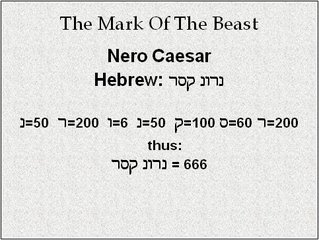
Interestingly enough, some ancient Latin transcripts have the number 616 instead of 666. While some believe this to be a copyist’s error, there is a better explanation. It just so happen that the gematria of the Latin form for Nero Caesar (nrw qsr) equals 616. This shows 2 things. 1.) The Latin translators were more concerned with the identity of the beast than any particular number. 2.) The Latin translators believed Nero to be the beast.
Objections
Two popular objections are easily refuted.
1.) This is an incorrect Hebrew spelling of Nero’s name.
“It is charged by some that Nerón Kesar is merely a convenient "misspelling" of Nero's name in Hebrew. This objection overlooks the fact that before the modern introduction of dictionaries the world was simply not as concerned as we are about uniformity in the spelling of names. Alternate spellings were common (e.g. "Joram" and "Jehoram" in the Old Testament), especially in the transliteration of words into a foreign tongue. But the allegation of misspelling is wholly wrong anyway. The form Nerón Kesar is the linguistically "correct" Hebrew form, is the form found in the Talmud and other rabbinical writings, and was used by Hebrews in the first century, as archaeological evidence has shown. As F. W. Farrar observed, "the Jewish Christian would have tried the name as he thought of the name —that is in Hebrew letters. And the moment he did this the secret stood revealed. No Jew ever thought of Nero except as 'Nerón Kesar' and this gives at once . . . 666" (The Early Days of Christianity, Chicago and New York: Belford, Clarke & Co., 1882, p. 540)." (Footnote #37 from David Chilton’s “Days of Vengeance p. 351)
“According to Stuart, Professor Benary of Berlin noted long ago that in the Talmud and other Rabbinical writings Nero was spelled thus. …It may now be pointed out that in an Aramaic document from Murabba'at . . . , dated to the "second year of the emperor Nero," the name is spelled nrwn qsr — as required by the theory [i.e., that 666 signifies Nero]. The last two consonants are damaged, but enough is preserved to show that no vowel-letter was written between the q and s. (Taken from Kenneth Gentry – Before Jerusalem Fell: Dating the Book of Revelation, p. 199)
2.) This is an in correct Hebrew gematria.
Some have suggested that the second N in NRWN should be the 'nun sofiet' or 'final nun' version, making its value 700 and thus making the actual value of the gematria 1316. However, this is false. The 'final nun' is a very specific Hebrew character under 'mispar hechrachi' or absolute value and to place it without the proper character in place doesn't work as to the rules of gematria. Furthermore, the “final” is not assigned to non-Hebrew words and as such would not apply to the gematria translation of NRWNQSR.
Conclusion
Despite the rantings of our modern day prophecy gurus, there is nothing in Scripture that points to a future worldwide dictator called “antichrist”. All of the individuals being referred to by alleged “antichrist” passages are long gone. As for the term "antichrist" itself, it refers to anyone who denies that Jesus is the Christ, including some of the kindest people you may know.
“There is no doubt that the Antichrist has already been born. Firmly established already in his early years, he will, after reaching maturity, achieve supreme power." – St. Martin of Tours (316-397 AD)
Introduction
One of the most popular (and misunderstood) items in Scripture is that of antichrist, and it seems to have been that way from among the earliest of Christians. It is often suggested that the term antichrist refers to a future Satanic World Dictator. The Rapture Ready Website defines Antichrist as “… the most evil man that will ever live. He will arrive on the world scene and appear to be the world's savior, but everyone on earth will soon learn his real mission will be one of destruction. Also called the man of lawlessness (or sin), Gog, the son of destruction (or perdition)” (Rapture Ready Glossary). The site goes on to tell us that “Ever since the Old Testament first spoke of him, Christians and Jews have been looking for the advent of the Antichrist. Daniel described him as the most evil man who ever will live”. (The Antichrist: Have You Seen This Man?)
This misunderstanding has lead to some creative speculation regarding antichrist. Th
 e Pope, Joseph Stalin, Adolf Hitler, Benito Mussolini, Ronald Reagan, Henry Kissinger, Bill Clinton, George Bush, Bill Gates are a few of many names that have been suggested. Any powerful world leader seems to be a candidate, especially if there is a way to find a number 6 in his name.
There are several problems with this view. First, contrary to the statement from Rapture ready above, the Old Testament does not speak of “antichrist”. Also, to the surprise of many, the word “antichrist” does not appear in either Daniel or Revelation. Second, it makes the assumption that Daniel’s little horn, Paul’s “man of sin”, John’s “antichrist”, and John’s “Beast” are all the same entity. These terms refer to at least three different people. Third, it ignores what the Bible itself says about antichrist.
Antichrist in Scripture
“Children, it is the last hour, and as you have heard that antichrist is coming, so now many antichrists have come. Therefore we know that it is the last hour.” (1 John 2:18)
“Who is the liar but he who denies that Jesus is the Christ? This is the antichrist, he who denies the Father and the Son. No one who denies the Son has the Father. Whoever confesses the Son has the Father also.” (1 John 2:22-23)
“…and every spirit that does not confess Jesus is not from God. This is the spirit of the antichrist, which you heard was coming and now is in the world already.” (1 John 4:3)
“For many deceivers have gone out into the world, those who do not confess the coming of Jesus Christ in the flesh. Such a one is the deceiver and the antichrist.” (2 John 1:7)
These are ALL of the passages in the Bible that refer to antichrist. Nothing is written here about a future, satanic world dictator. What can we glean from these passages?
1.) Antichrist had already come in the first century. It was how John’s readers knew that “it was the last hour” (1 John 2:18). At the time John was writing, antichrist was “in the world already.” (1 John 4:3). John's message was clear. The current age (the Old Mosaic Covenant) was about to end. It was "the last hour".
2.) Antichrist is defined as “he who denies that Jesus is the Christ” (1 John 2:22), “every spirit that does not confess Jesus is not from God” (1 John 4:3), and “deceivers …who do not confess the coming of Jesus Christ in the flesh” (2 John 1:7). John seems, in particular, to be referring to Judaizers in the church, for he adds, “No one who denies the Son has the Father. Whoever confesses the Son has the Father also.” (1 John 2:23). Who else, at that time, would have claimed to have the Father while denying the Son? Thus Paul wrote to the Philippian Church, “Look out for the dogs, look out for the evildoers, look out for those who mutilate the flesh. For we are the real circumcision, who worship by the Spirit of God and glory in Christ Jesus and put no confidence in the flesh -” (Philippians 3:2-3).
Paul’s “man of lawlessness”
It is more than likely that Paul was referring to the same thing when he writes about the “man of lawlessness” (2 Thessalonians 2:3), though he may have been referring to the high priest in particular. This person was someone that the Thessalonian church would see, for Paul begins with a warning not to be deceived (2 Thessalonians 2:3). The person was someone who “takes his seat in the temple of God” (2 Thessalonians 2:4), thus was someone who practiced Judaism. Paul warns that “the mystery of lawlessness is already at work” (2 Thessalonians 2:7) in the first century, thus eliminating any 21st Century candidate from contention. It was the high priests and Pharisees that Christ had promised to destroy “by the appearance of his coming” (2 Thessalonians 2:8 cf. Matthew 21:40-45). Thus Paul, a Hebrews of Hebrews (Philippians 3:5) who would have given his own soul for the salvation of his countrymen (Romans 9:3), did not harbor the modern dispensational delusion that Christ-rejecting Judaists were still “God’s chosen people”.
The Beast of Revelation
The Prophecies in Daniel mainly concern the end of the Old Covenant, from the time of Nebuchadnezzar’s Babylon to the Roman Empire, the four beasts being the empires of Babylon, Persia, Greece, and Rome. Commenting on Daniel 7:7, the Rapture Ready Website tells us “In the reference to the 10 horns we again jump from history to prophecy, from the ancient Roman Empire to its revival in our times”. (The End Times According To Daniel Part One). Contrary to much of the exposition in dispensational circles, nothing is said about the Roman Empire being “revived in our time”. The Roman Empire is dead, and there is no reason to believe that it will be revived again at any time. The symbols in Daniel that are assumed to be “antichrist” actually refer to people in the ancient world, ranging from Antiochus Epiphanes to Herod the Tetrarch. I may give a detailed exposition on the prophecies of Daniel at a later time, but for now, I want to focus on the identity of the fourth beast, the one that John writes about in Revelation.
No character in the history of the world has invoked such dread and superstition as the Beast. Kenneth Gentry has written an excellent article in defense of the Beast being the Roman Empire, under the reign of Nero Caesar. (See The Beast of Revelation Identified). I’ll highlight some of the scripture proof here.
On July 19, A.D. 64, the great Roman fire, which destroyed most of Rome, broke out. Although he was out of Rome at the time, suspicion was cast upon Nero for causing the fire. We already identified Nero as the emperor who was reigning at the time that John wrote Revelation (See Revelation 17:10 and Dating the Book of Revelation). Many were convinced that since he deplored the ugliness of Rome he intended to destroy it to make room for more of his own building projects. In order to turn attention from himself, he falsely accused Christians of having started the fire and punished them for being “given to a new and mischievous superstition”. This became the first Imperial persecution of the church, and the Apostles Peter and Paul themselves became two of Nero’s victims. According to L. Von Mosheim (who was not a preterist), the Neronic persecution began in November of 64 AD, and didn’t end until Nero’s suicide in June of AD 68, a period of almost exactly 42 months. (Revelation 13:5). Due to Nero’s excesses and his constant absence from Rome, the Senate voted to put Nero to death. Thus Nero implored a servant to stab him the throat with his own sword (Revelation 13:10).
The Mark of The Beast
“I wouldn't totally rule out any other meaning to the appearance of the number 666. For example, a Halloween lottery pick-3 drawing once turned up 666 as the winning number. We may have to allow for the occasional sovereignty of God in His attempt to warn folks of the evils of this world--in this case, gambling and Halloween. If there's a wayward Christian at a convenience store buying a dirty magazine or a bottle of booze and the register rings up $6.66, I couldn't think of a better number for God to use to get that person's attention.” (The Number of the Beast – Rapture Ready Website)
We can only smile at the type of nonsense typified by the above quote. While modern prophecy buffs look to answers in credit cards, computer chips implants, theme park validations, and bar code scanners, they once again ignore John’s original audience. What did the “mark” mean to them? We can look first at similar language in God's Commandments concerning the binding of the law in Deuteronomy 6:6-8. The mark of the beast is no more a literal mark than the binding of the law required a literal rope. The mark of the beast is simply "the number of his name" (Revelation 13:17). By the time a first century reader got to the 13th chapter of Revelation, they would have known that the Beast, by John’s description, was Nero’s Rome. Indeed, they would have known this from the 7th chapter of Daniel. But John gives another clue; a Jewish numeric riddle known as a gematria. The numerical values for a gematria can be found here.
By applying the gematriac values to the Hebrew form of Nero Caesar, we come up with the following:
Interestingly enough, some ancient Latin transcripts have the number 616 instead of 666. While some believe this to be a copyist’s error, there is a better explanation. It just so happen that the gematria of the Latin form for Nero Caesar (nrw qsr) equals 616. This shows 2 things. 1.) The Latin translators were more concerned with the identity of the beast than any particular number. 2.) The Latin translators believed Nero to be the beast.
Objections
Two popular objections are easily refuted.
1.) This is an incorrect Hebrew spelling of Nero’s name.
“It is charged by some that Nerón Kesar is merely a convenient "misspelling" of Nero's name in Hebrew. This objection overlooks the fact that before the modern introduction of dictionaries the world was simply not as concerned as we are about uniformity in the spelling of names. Alternate spellings were common (e.g. "Joram" and "Jehoram" in the Old Testament), especially in the transliteration of words into a foreign tongue. But the allegation of misspelling is wholly wrong anyway. The form Nerón Kesar is the linguistically "correct" Hebrew form, is the form found in the Talmud and other rabbinical writings, and was used by Hebrews in the first century, as archaeological evidence has shown. As F. W. Farrar observed, "the Jewish Christian would have tried the name as he thought of the name —that is in Hebrew letters. And the moment he did this the secret stood revealed. No Jew ever thought of Nero except as 'Nerón Kesar' and this gives at once . . . 666" (The Early Days of Christianity, Chicago and New York: Belford, Clarke & Co., 1882, p. 540)." (Footnote #37 from David Chilton’s “Days of Vengeance p. 351)
“According to Stuart, Professor Benary of Berlin noted long ago that in the Talmud and other Rabbinical writings Nero was spelled thus. …It may now be pointed out that in an Aramaic document from Murabba'at . . . , dated to the "second year of the emperor Nero," the name is spelled nrwn qsr — as required by the theory [i.e., that 666 signifies Nero]. The last two consonants are damaged, but enough is preserved to show that no vowel-letter was written between the q and s. (Taken from Kenneth Gentry – Before Jerusalem Fell: Dating the Book of Revelation, p. 199)
2.) This is an in correct Hebrew gematria.
Some have suggested that the second N in NRWN should be the 'nun sofiet' or 'final nun' version, making its value 700 and thus making the actual value of the gematria 1316. However, this is false. The 'final nun' is a very specific Hebrew character under 'mispar hechrachi' or absolute value and to place it without the proper character in place doesn't work as to the rules of gematria. Furthermore, the “final” is not assigned to non-Hebrew words and as such would not apply to the gematria translation of NRWNQSR.
Conclusion
Despite the rantings of our modern day prophecy gurus, there is nothing in Scripture that points to a future worldwide dictator called “antichrist”. All of the individuals being referred to by alleged “antichrist” passages are long gone. As for the term "antichrist" itself, it refers to anyone who denies that Jesus is the Christ, including some of the kindest people you may know.
Monday, December 11, 2006
Revelation: The Conquering Christ and the Overcoming Church
“And Jesus came and said to them, ‘All authority in heaven and on earth has been given to me. Go therefore and make disciples of all nations, baptizing them in the name of the Father and of the Son and of the Holy Spirit, teaching them to observe all that I have commanded you. And behold, I am with you always, to the end of the age.’" (Matthew 28:18-20)
“When, in God's estimation, the world reaches the point of global rejection of Christ, then, as with Israel before her global deportation, God will recall His ambassador-the church-before the judgment of the tribulation.” (Tim LeHaye – Prophecy Q&A)
Will the church fail in the task that Christ has given her to do? Tim LeHaye seems to think so. His view emanates through the minds of the modern church. The world is a “sinking ship”, and the Christians only hope is to get “raptured” out of the mess. This is the clear difference between Premillennialism and Biblical Postmillennialism, which teaches that the Great Commission will be a success, not a failure, in this church age.
Having established the Date of Revelation as being prior to the destruction of Jerusalem in 70 AD, as well as holding to consistency in respect to the time frame references and original audience, it becomes much easier to establish this consistent theme. During the New Testament time period, the Church was being persecuted by “false Jews”, i.e. those who claimed to be heirs of God’s kingdom based on their physical lineage to Abraham. This is clear through a number of Scriptures. (For just a handful of examples, see Acts 5:18-18; Acts 6:8-7:60; Acts 9:22-23; Acts 12:1-3; Acts 13:50; Acts 14:2; Romans 2:28-29; Philippians 3:2-3; Rev. 2:9).
However, when John wrote what was, in essence, his version of the Olivet Discourse, a newer and greater persecution of the Church was taking place. The Great Fire of 64 AD had destroyed much of Rome. Most historians believe that the Emperor Nero, who deplored the ugliness of Rome, set the fire himself to enable him to rebuild it as he saw fit. Nero, needing a scapegoat, blamed it on those who practiced a “new sect of Judaism” called Christians. It was the first, and the worst, Imperial persecution of the church, a “great tribulation, such as has not been from the beginning of the world until now, no, and never will be.” (Matthew 24:21). In fact, John himself was exiled to the island of Patmos as a partaker in the tribulation (Revelation 1:9).
Neither Jesus nor John promised their listeners anything resembling a “pre-trib” rapture. In fact, Jesus warned his disciples that “they will deliver you up to tribulation and put you to death, and you will be hated by all nations for my name's sake.” (Matthew 24:9). St. John Apocalypse gave similar warnings, “Do not fear what you are about to suffer. Behold, the devil is about to throw some of you into prison, that you may be tested, and for ten days you will have tribulation. Be faithful unto death, and I will give you the crown of life.” (Revelation 2:10). The message of Revelation, to the Church, was not one of escape, but one of endurance, overcoming, and conquering.
“The one who conquers will not be hurt by the second death.” (Revelation 2:11)
“To the one who conquers I will give some of the hidden manna, and I will give him a white stone, with a new name written on the stone that no one knows except the one who receives it.” (Revelation 2:17)
“Only hold fast what you have until I come. The one who conquers and who keeps my works until the end, to him I will give authority over the nations,” (Revelation 2:25-26).
“The one who conquers will be clothed thus in white garments, and I will never blot his name out of the book of life. I will confess his name before my Father and before his angels.” (Revelation 3:5)
“Because you have kept my word about patient endurance, I will keep you from the hour of trial that is coming on the whole world, to try those who dwell on the earth. I am coming soon. Hold fast what you have, so that no one may seize your crown. The one who conquers, I will make him a pillar in the temple of my God. Never shall he go out of it, and I will write on him the name of my God, and the name of the city of my God, the new Jerusalem, which comes down from my God out of heaven, and my own new name.” (Revelation 3:10-12)
“The one who conquers, I will grant him to sit with me on my throne, as I also conquered and sat down with my Father on his throne.” (Revelation 3:21)
“And I looked, and behold, a white horse! And its rider had a bow, and a crown was given to him, and he came out conquering, and to conquer.” (Revelation 6:2)
“They will make war on the Lamb, and the Lamb will conquer them, for he is Lord of lords and King of kings, and those with him are called and chosen and faithful." (Revelation 17:14)
It was this attitude that moved the Puritans to build the London and Scottish Missionary Societies. It was this belief that enabled believers to conquer darkness in pagan worlds, preaching the gospel and smashing idols, sometimes at the cost of their own lives. Contrast this with the modern day Dispensational theology that tells is that…
1.) God’s law is no longer valid.
2.) The world belongs to antichrist and the church is helpless to do anything about it.
If Satan wanted to draw up a theology to render the church of Jesus Christ impotent, what better plan could he come up with? May the Church of Jesus Christ recapture the postmillennial theology of overcoming the evil one.
For More Information, see:
The Puritan Hope by Iain Murray
Postmillennialism: An Eschatology of Hope by Keith Mathison
Subscribe to:
Posts (Atom)